How to Choose Lead Distribution Software: The Buyer's Guide for 2026
A decision framework for evaluating lead distribution software. 10 features to compare, red flags to avoid, and how to match a platform to your operation.

Rafael Hernandez
Founder & CEO
Ex-Microsoft SWE · $10M+ PPL ad spend
I hope you enjoy reading this blog post. If you want to try Lead Distro AI for free, click here.
Author: Rafael Hernandez | Founder & CEO of Lead Distro AI
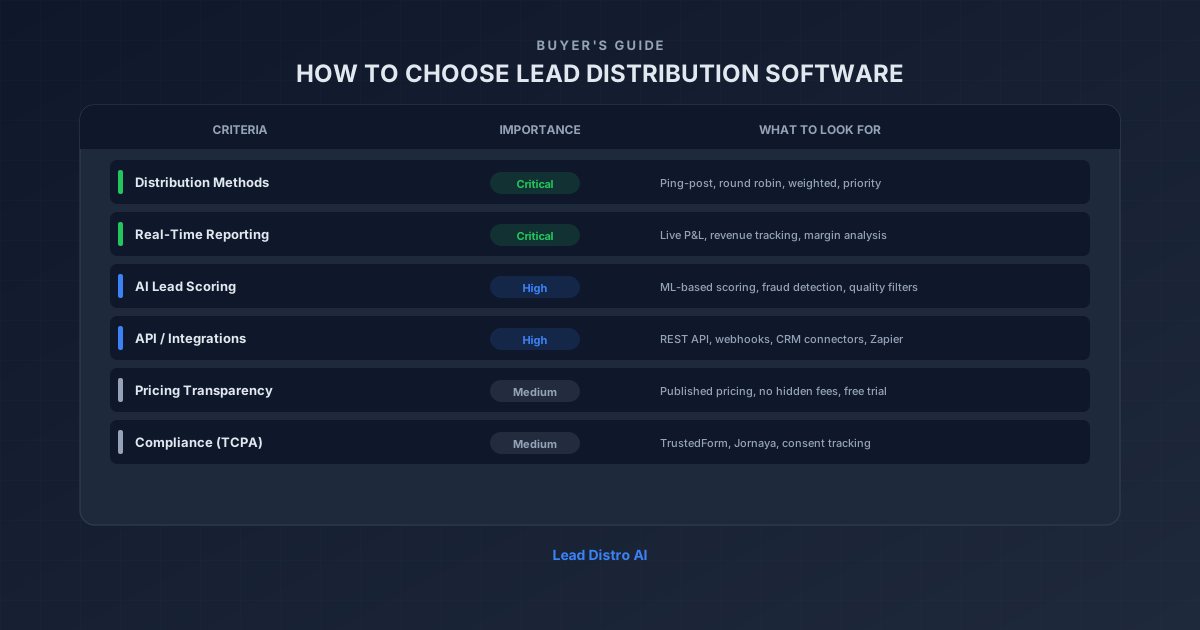
The right lead distribution software will increase your revenue per lead, reduce manual work, and give you real-time visibility into margins. The wrong one will slow your routing, frustrate your buyers, and cost you deals. This buyer's guide covers the 10 features that separate great platforms from mediocre ones, the red flags to watch for during demos, and a scoring framework you can use to objectively compare any lead distribution platform on the market in 2026.
In short: prioritize routing speed, lead scoring, pricing transparency, and real-time P&L tracking. If a platform cannot route a lead in under five seconds, score it for quality before delivery, or show you margin per source in real time, it is not built for modern pay-per-lead operations. If you want to skip the framework and jump directly to a ranked comparison, see our roundup of the best lead distribution software for 2026.
Key Takeaways
- The 10 most important features to evaluate are distribution methods, lead scoring, speed, P&L reporting, buyer portal, duplicate detection, compliance tools, API flexibility, pricing model, and support quality.
- Lead distribution software should route leads in under one second. Companies that respond within five minutes are 100x more likely to connect (Harvard Business Review, 2011).
- Rule-based lead scoring is the single biggest differentiator between modern and legacy platforms. Lead Distro AI scores every inbound lead against your rules before routing.
- Avoid platforms with no published pricing, no free trial, and setup timelines measured in weeks.
- Use the evaluation scorecard at the end of this guide to compare platforms objectively.
1. Distribution Methods: How Many Do You Need?
The first question when evaluating lead distribution software is whether it supports the routing methods your business model requires. If routing is your primary concern, our best lead routing software comparison ranks the top platforms by routing speed and method support. There are four primary distribution methods, and the best platforms support all of them:
- Waterfall: First buyer that matches gets the lead. Best for exclusive lead deals.
- Round robin: Equal distribution across buyers. Best for balanced volume contracts.
- Weighted: Proportional distribution based on buyer priority or performance. Best for preferred buyer relationships.
- Ping-post: Multiple buyers bid on partial lead data in real time. Best for maximizing revenue per lead in competitive verticals.
Ask each vendor which of the four methods it supports on your plan. If you run a lead marketplace or sell into competitive verticals like insurance and legal, you need ping-post. Lead Distro AI's smart lead routing engine supports waterfall, round robin, and weighted on every plan, and ping-post from the $497/mo Growth plan. Boberdoo and Ping Tree Systems also support ping-post. See the full lead distribution models comparison for detailed use cases.
2. Lead Scoring: The Biggest Differentiator
A single hardcoded filter like "reject if phone number is invalid" catches obvious junk but cannot evaluate lead quality holistically. Rule-based lead scoring lets you configure scoring rules across every field on a lead and produces a quality score that buyers can use to filter before accepting.
When evaluating platforms, ask:
- Does the platform score leads before or after routing?
- Can you configure your own scoring rules, or is the model fixed?
- Can buyers set minimum score thresholds for lead acceptance?
- What fields does the scoring engine evaluate?
Lead Distro AI scores every lead against your configured rules in under one second, evaluating all submitted fields before routing begins.
3. Routing Speed: Sub-Second or Nothing
Speed is non-negotiable. Research from InsideSales.com shows that 78% of deals go to the vendor that responds first (InsideSales.com, 2023). Your lead distribution software is the bottleneck between lead submission and buyer contact.
What to benchmark during your evaluation:
- Ingest-to-delivery time (should be under 1 second for web leads)
- Ping-post round-trip time (should be under 500 milliseconds)
- API response time under load (test with your expected volume)
"If your lead distribution platform takes more than five seconds to route a lead, you are losing money on every lead that passes through it," says Rafael Hernandez, Founder & CEO of Lead Distro AI. "Sub-second routing is not a premium feature. It is the minimum bar."
4. Real-Time P&L Tracking
Volume metrics (leads delivered, acceptance rate, rejection rate) are useful, but the metric that actually matters is profit margin per lead, per source, per buyer, per campaign.
When choosing lead distribution software, look for:
- Revenue tracking per buyer with real-time updates, not end-of-month reconciliation
- Cost tracking per source tied to your acquisition spend
- Margin calculation that subtracts cost from revenue automatically
- Dashboard filtering by date range, source, buyer, campaign, and vertical
Without real-time P&L, you are flying blind. You might be running traffic sources that look productive by volume but are actually unprofitable once you factor in acquisition cost. Lead Distro AI's profit dashboard tracks revenue, cost, and margin at the source, campaign, and buyer level in real time.
5. Buyer Portal and Self-Service Caps
Your buyers are your customers. The easier you make it for them to manage their accounts, the longer they stay and the more they spend. Evaluate whether the platform offers:
- Self-service cap management: Buyers set their own daily/weekly/monthly lead caps without calling your team
- Lead review interface: Buyers can review, accept, or dispute leads directly
- Reporting access: Buyers see their own delivery volume, conversion rates, and spend
- White-label options: The portal looks like your brand, not the software vendor's
A strong buyer portal reduces your support load and increases buyer retention. If a platform requires you to manually adjust caps via email or phone, it is not built for scale.
6. Duplicate Detection and Data Validation
Duplicate leads waste buyer trust and your reputation. Before a lead enters the routing engine, the platform should check for:
- Phone number duplicates against a configurable lookback window (7, 14, 30, 90 days)
- Email duplicates across your entire lead database
- Custom field matching (e.g., case type + zip code combinations)
- Phone connectivity validation to catch disconnected or invalid numbers
- Data format validation for required fields
Lead Distro AI performs duplicate detection and data validation before lead scoring, so buyers never receive duplicate or invalid leads. See our guide on how duplicate leads cost PPL agencies real money.
7. Compliance and Consent Tools
TCPA violations carry penalties of $500 to $1,500 per call. The FCC's one-to-one consent rule (effective January 2025) requires leads to consent to contact from a specific named seller. Your lead distribution software must support:
- TrustedForm certificate storage or equivalent consent verification
- Consent language tracking with timestamps
- Jornaya LeadiD integration for compliance auditing
- Call recording storage for live transfer compliance
- Do-not-call list checking before outbound delivery
87% of lead buyers now require proof of consent before accepting leads (Performance Marketing Association, 2024). If your platform cannot prove consent at the individual lead level, you are exposed.
8. API Flexibility and Integrations
Your lead distribution software sits at the center of your tech stack. It needs to connect with your traffic sources, CRMs, call platforms, and analytics tools. Evaluate:
- Inbound API: Can you post leads from any source via webhook or REST API?
- Outbound delivery: Does the platform deliver to buyer CRMs, custom endpoints, and email?
- CRM integrations: Native connections to Salesforce, HubSpot, GoHighLevel, and others
- Zapier/Make support: For no-code integrations with tools the platform does not natively support
- API documentation quality: Can your developer integrate within a day?
Read our lead distribution API guide for the technical details on what a well-designed API should include.
9. Pricing Model: What to Watch For
Lead distribution software pricing falls into three models:
| Model | How It Works | Best For | Watch Out For |
|---|---|---|---|
| Per-lead pricing | Pay $0.01-$0.05 per lead processed | Low volume (under 5,000/mo) | Costs escalate quickly at scale |
| Monthly subscription | Flat fee per tier | Predictable budgeting at any volume | May include lead caps per tier |
| Custom/enterprise | Negotiated rate, annual contract | 50K+ leads/month | No pricing transparency, long sales cycle |
If you are evaluating platforms at the top of the market, see our enterprise lead distribution software buyer's guide for the 12 features, security checklist, and vendor evaluation questions specific to enterprise deployments.
Lead Distro AI uses monthly subscription pricing: $297/mo Starter (2,500 leads), $497/mo Growth (5,000 leads). Scale (15,000+ leads) is priced by quote; talk to sales. All plans include lead scoring and round robin, weighted, and priority/waterfall routing; ping-post starts on Growth. For comparison, boberdoo publishes volume-based tiers starting at $1,075/mo billed monthly (as of September 2026).
Red flags on pricing:
- No published pricing on the website
- Requiring a demo before sharing any price
- Charging extra for core features like ping-post or reporting
- Annual contracts with no monthly option
- Setup fees over $500
Use the lead pricing calculator to model your unit economics before committing.
10. Support and Onboarding
The best lead distribution software is useless if you cannot get help when routing breaks or a buyer integration fails. Evaluate:
- Support channels: Email, chat, phone, or Slack?
- Response time SLA: What is the guaranteed response time for critical issues?
- Onboarding process: Self-serve setup or dedicated onboarding specialist?
- Documentation quality: Is there a searchable knowledge base with API docs?
- Time to first lead: How quickly can you route your first lead after signing up?
Lead Distro AI offers self-serve setup with documentation, a product tour, and email/chat support. Most agencies route their first lead within hours, not weeks.
Platform Evaluation Scorecard
Use this scorecard to compare platforms objectively. Rate each criterion from 1 (poor) to 5 (excellent):
| Criterion | Weight | Platform A | Platform B | Platform C |
|---|---|---|---|---|
| Distribution methods (all 4) | 15% | _ / 5 | _ / 5 | _ / 5 |
| Lead scoring | 15% | _ / 5 | _ / 5 | _ / 5 |
| Routing speed (sub-second) | 10% | _ / 5 | _ / 5 | _ / 5 |
| Real-time P&L tracking | 10% | _ / 5 | _ / 5 | _ / 5 |
| Buyer portal | 10% | _ / 5 | _ / 5 | _ / 5 |
| Duplicate detection | 10% | _ / 5 | _ / 5 | _ / 5 |
| Compliance tools | 10% | _ / 5 | _ / 5 | _ / 5 |
| API and integrations | 5% | _ / 5 | _ / 5 | _ / 5 |
| Pricing transparency | 10% | _ / 5 | _ / 5 | _ / 5 |
| Support and onboarding | 5% | _ / 5 | _ / 5 | _ / 5 |
| Weighted Total | 100% | _ / 5 | _ / 5 | _ / 5 |
Multiply each score by its weight percentage, then sum. The platform with the highest weighted total is your best fit.
FAQ
What is the most important feature in lead distribution software?
Rule-based lead scoring is the most important feature because it directly impacts conversion rates and buyer satisfaction. Automated scoring lets buyers filter by quality before a lead is ever delivered, instead of relying on manual review. The second most important feature is routing speed, since 78% of deals go to the first responder. Look for platforms that score and route in under one second.
How much should lead distribution software cost?
Pricing ranges from $0.02 per lead (usage-based) to custom, quote-based subscriptions at higher volume. For agencies processing 1,000-5,000 leads per month, expect to pay $297-$497 per month for a full-featured platform. Avoid platforms that charge extra for core features like ping-post, reporting, or API access. Published pricing is a green flag; requiring a sales call for any pricing information is a red flag.
How long does it take to set up lead distribution software?
Modern platforms like Lead Distro AI can be set up in hours with self-serve onboarding, API documentation, and pre-built integrations. Setup time varies by vendor, so ask each one how long it takes to route your first live lead. Ask for a free trial so you can test the actual setup process before committing to a contract.
Should I choose a platform that specializes in my vertical?
Vertical specialization matters for compliance and buyer network, but platform capability matters more. A platform that supports all four distribution methods, lead scoring, and TCPA compliance tools can serve any vertical effectively. Look for platforms with experience in your vertical (legal, insurance, solar, mortgage) but do not sacrifice core features for vertical specialization.
What is the difference between lead distribution and lead management software?
Lead distribution software focuses on routing leads to external buyers or sales reps in real time, optimizing for speed, revenue, and buyer match. Lead management software is broader, covering the entire lead lifecycle from capture to nurture to close, typically for internal sales teams. PPL agencies and lead brokers need distribution software specifically. See our comparison of the best lead management software for the full breakdown.
Conclusion
Choosing lead distribution software comes down to 10 criteria, but the four that matter most are distribution methods, lead scoring, routing speed, and real-time P&L tracking. If a platform nails these four, the rest are table stakes. If it misses any of them, it will cost you leads, margin, and buyer trust.
Lead Distro AI scores highest across all 10 criteria in our evaluation because it combines lead scoring, four distribution methods, sub-second routing, and real-time profit tracking in a single system. Start your 7-day free trial to evaluate it yourself using the scorecard above.
Already evaluating platforms? Take the dashboard tour to see Lead Distro AI's routing, scoring, and real-time P&L dashboard in action before your next vendor demo.
About the Author
Founder & CEO of Lead Distro AI & Great Marketing AI
UC Berkeley graduate and former software engineer at Microsoft. Rafael built Lead Distro AI after managing over $10M in ad spend for performance marketing agencies (pay-per-lead and pay-per-call), including running campaigns for Neil Patel. He combines deep software engineering expertise with hands-on performance marketing experience to build tools that help these agencies scale profitably.
About Lead Distro AI
Lead Distro AI: AI-Powered Lead Distribution & Call Tracking That Maximizes ROI
The modern platform for pay-per-lead and pay-per-call agencies. Route, score, and deliver leads with AI-powered automation and real-time P&L tracking. Built for performance marketing agencies and lead buyers across legal, insurance, mortgage, solar, and home services verticals.
4 Distribution Methods
Waterfall, Round Robin, Weighted, Ping-Post
Ping-Post Auctions
Real-time bidding with sub-second routing
Real-Time P&L Reporting
Track revenue, costs, and profit per campaign
Call Tracking
Assign tracking numbers, record calls, and attribute conversions
Lead Scoring
Score every lead before routing to maximize conversion
Partner Portal
Self-serve dashboard for buyers to track leads