Ping Post Lead Distribution: How Real-Time Bidding Maximizes Lead Revenue
Learn how ping post lead distribution works, why it maximizes revenue per lead, and how to set up real-time bidding for your lead generation business.

Rafael Hernandez
Founder & CEO
Ex-Microsoft SWE · $10M+ PPL ad spend
I hope you enjoy reading this blog post. If you want to try Lead Distro AI for free, click here.
Author: Rafael Hernandez | Founder & CEO of Lead Distro AI
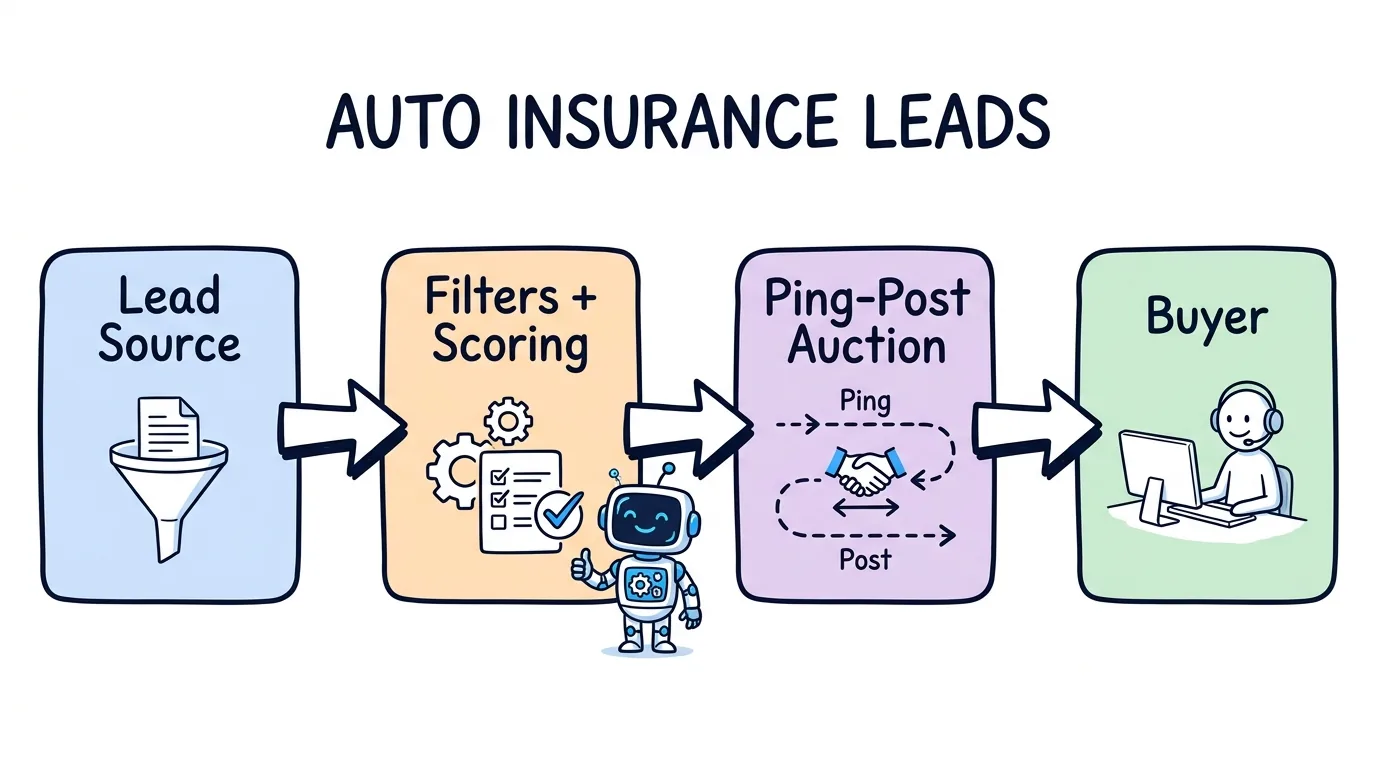
Ping post is a real-time bidding method for lead distribution where lead sellers share partial lead data (the "ping") with multiple buyers, collect bids, and then send the full lead (the "post") to the winning bidder. It is the most profitable distribution method for lead sellers in competitive verticals because it creates buyer competition on every single lead, driving prices up to true market value rather than a single fixed rate set in advance.
If you run a pay per lead business, ping post is likely the single biggest lever you have for increasing revenue without generating more leads. Instead of selling leads at a fixed price or routing them down a waterfall, you let buyers compete in real time. The result: your best leads go to the buyer willing to pay the most, and your average lead value climbs. Lead Distro AI supports ping post out of the box via the dedicated ping post engine, along with waterfall, round robin, and weighted distribution.
For the full category primer, read our cornerstone guide on what ping post is. To decide between the two real-time models, see our ping post vs direct post comparison.
Key Takeaways
- Ping post creates a live auction for every lead, ensuring sellers always get the highest available price.
- Buyers only pay for leads that match their filters, reducing waste and improving conversion rates.
- The ping phase shares only partial data, protecting consumer privacy until a buyer commits.
- Ping post works best in competitive verticals like legal, insurance, home services, and financial services.
- Setup requires proper API integrations, but modern lead distribution platforms handle the heavy lifting.
What Is Ping Post?
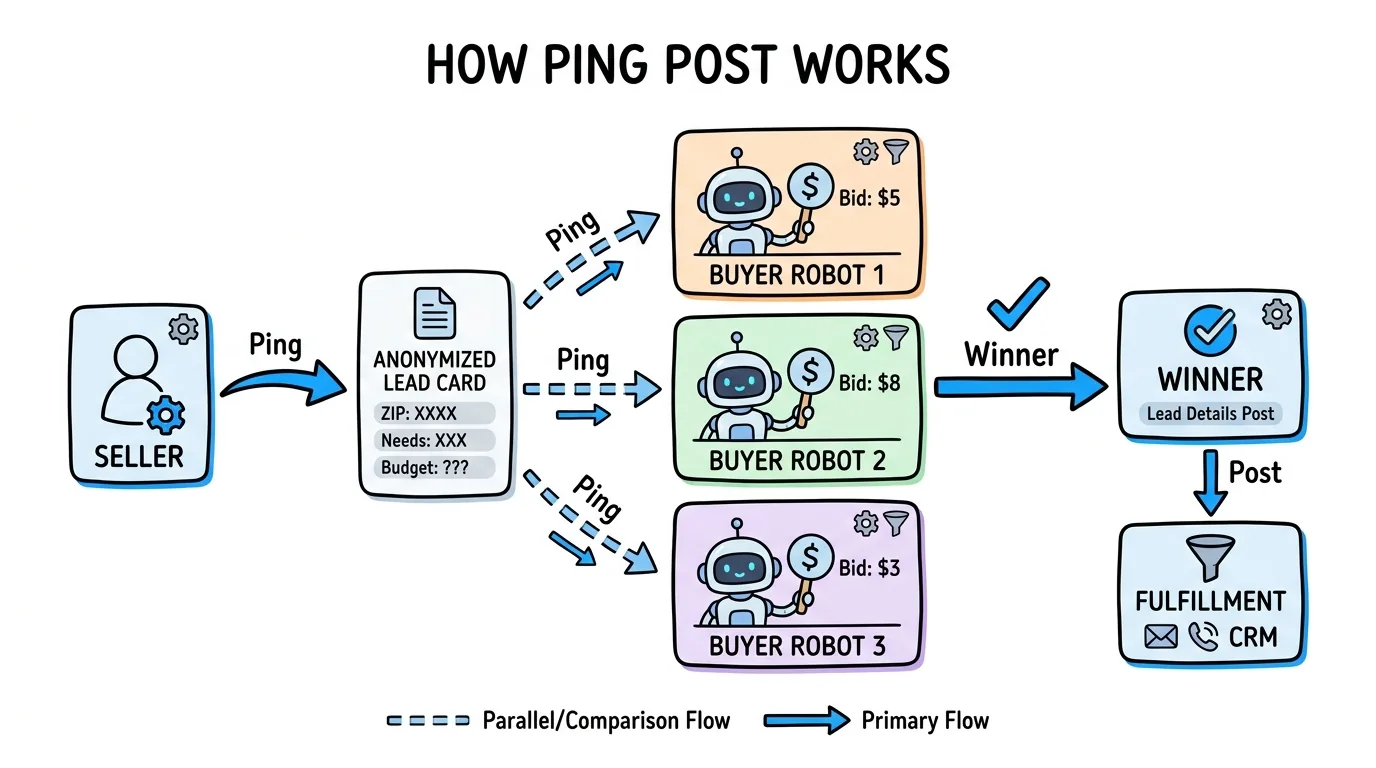
Ping post is a two-phase lead distribution method built around real-time bidding. Unlike static methods such as round robin or waterfall routing, ping post treats every lead as an individual auction. The seller broadcasts limited lead details to qualified buyers, buyers respond with a price they are willing to pay, and the seller routes the full lead to the highest bidder.
Today, ping post is the standard in verticals where lead values vary significantly based on geography, case type, or consumer intent. In legal lead generation, for example, a personal injury lead from Los Angeles may be worth three to five times more than the same lead type from a rural market. Ping post captures that price difference automatically.
What makes ping post different from other lead routing methods is that the buyer sets the price, not the seller. Market-driven pricing removes guesswork and ensures every lead sells at its true competitive value.
How Ping Post Works Step by Step
The ping post process happens in milliseconds. Here is what happens behind the scenes when a lead enters the system:
Phase 1: The Ping
- Lead capture - A consumer fills out a form, clicks an ad, or calls a tracking number.
- Data extraction - The system pulls key fields: zip code, state, lead type, and qualifying details. This partial data becomes the ping payload.
- Buyer matching - The platform identifies all buyers whose filters match the lead.
- Ping broadcast - Partial data is sent simultaneously to all matched buyers via API.
- Bid collection - Each buyer's system evaluates the ping and responds with a bid price (or rejection) within the timeout, typically 500 to 2,000 milliseconds.
Phase 2: The Post
- Winner selection - The platform ranks bids and selects the highest bidder (or top N bidders for shared leads).
- Full data delivery - The complete lead record is posted to the winning buyer.
- Confirmation - The buyer confirms acceptance. If rejected, the lead cascades to the next highest bidder.
Example: A legal lead gen company captures a motor vehicle accident lead from Houston, TX. The ping goes out to 12 matched law firm buyers. Bids come back ranging from $45 to $120. The $120 bidder wins and receives the full lead. Without ping post, that lead might have sold at a flat $65.
Ping Post vs. Other Distribution Methods
| Feature | Waterfall | Round Robin | Weighted | Ping Post |
|---|---|---|---|---|
| Pricing model | Fixed price | Fixed price | Fixed price | Dynamic bidding |
| Revenue optimization | Low | Low | Medium | High |
| Buyer competition | None | None | None | Real-time auction |
| Lead matching | Priority order | Rotation | Proportional | Best-fit + highest bid |
| Speed | Fast | Fast | Fast | Fast (under 2 seconds) |
| Best for | Exclusive deals | Fair distribution | Volume tiers | Maximizing per-lead revenue |
| Complexity | Low | Low | Low | Medium |
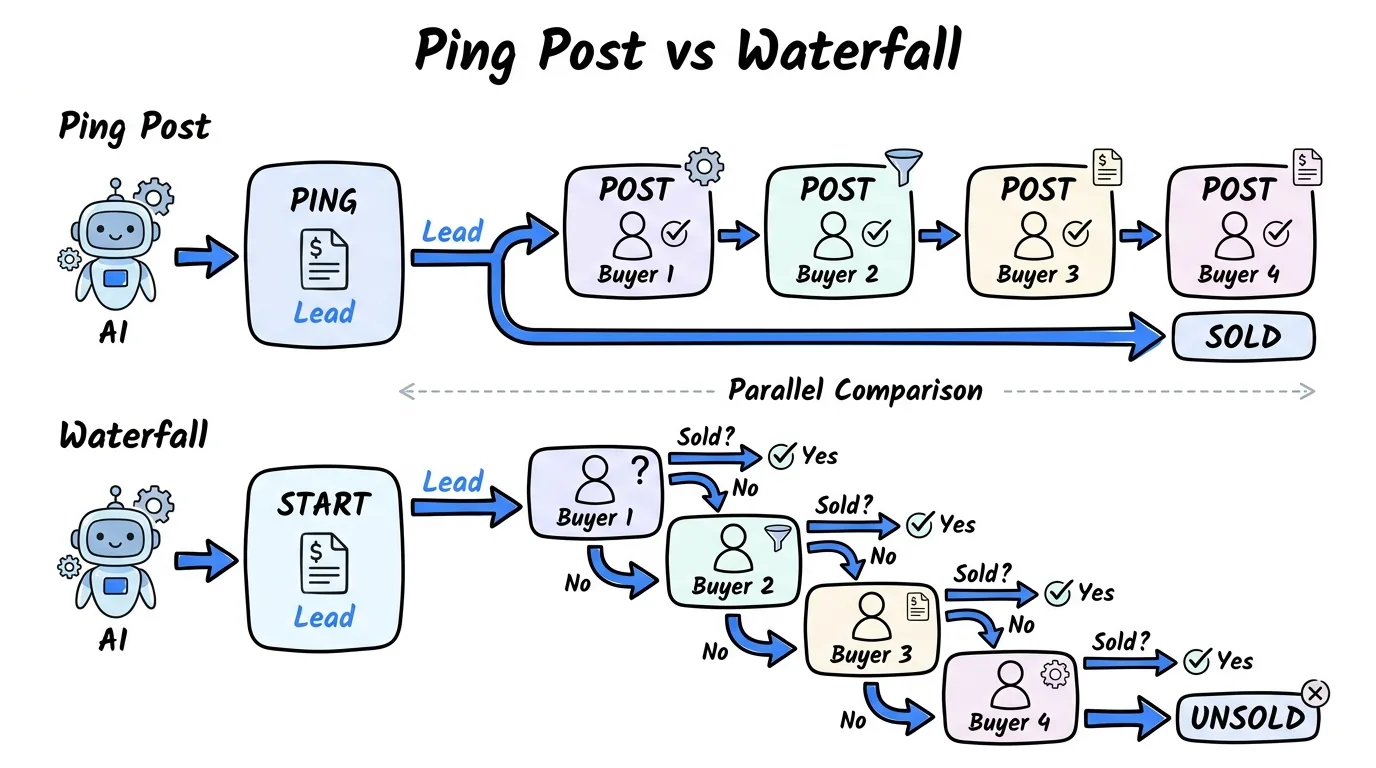
Dynamic ping post auctions tend to generate more revenue per lead than fixed-price distribution in competitive verticals, because the price floats to whatever a qualified buyer is willing to pay rather than what the seller guessed at the start of the month. The tradeoff is slightly more setup complexity, but platforms like Lead Distro AI handle the technical infrastructure so you can focus on growing your buyer network.
Worked Example: Ping Post vs. Waterfall in Auto Insurance
The math is easier to feel with a concrete scenario. Auto insurance lead pricing in 2025-2026 typically ranges from roughly $25 on the low end to $60 or more for high-intent shared leads, based on published rate cards from QuoteWizard's lead pricing guide and the lead-buying breakdowns at Insurance Leaders Group. The exact number any one seller earns depends on geography, age of lead, filter match rate, and buyer demand on the day.
Here is an illustrative comparison for a hypothetical 100-lead-per-month auto insurance seller. The numbers are plausible mid-market estimates, not customer data:
| Metric | Waterfall (fixed price) | Ping Post (auction) |
|---|---|---|
| Volume | 100 leads | 100 leads |
| Average price per lead | $30 (fixed list rate) | $38 (market-clearing bid) |
| Unsold leads in the month | 12 (no priority-1 buyer match) | 5 (broader buyer pool matches more) |
| Gross revenue | $2,640 | $3,610 |
| Time to first delivery | Less than 1 second | Less than 2 seconds |
In this illustrative example, the auction model produces about 37% more revenue from the same lead volume, without any new traffic. The gain comes from two sources: a higher average sale price when multiple buyers compete, and fewer leads that hit the floor of the waterfall and never sell. The mechanism is general, not insurance-specific. The same logic applies in legal, solar, and mortgage verticals, where lead values vary widely by zip code, case type, and buyer urgency.
The actual lift in your business will depend on how many buyers you can put into the auction, how tight their filters are, and how aggressive their bid floors are. The point of the example is the directional effect, not the specific dollar amount. Use the lead pricing calculator to model your own numbers before committing to a routing model.
Benefits of Ping Post for Lead Sellers
Higher revenue per lead. When multiple buyers compete on every lead, prices naturally rise to market value. Leads that would sell at a flat rate in a waterfall system consistently fetch higher prices in a ping post auction.
Automatic price discovery. The market tells you what each lead is worth in real time. This is especially valuable in verticals where lead values shift based on seasonality, geography, or regulatory changes.
Full transparency. Every transaction is logged: the ping, all bids received, the winning bid, and delivery confirmation. This audit trail simplifies buyer relationships and dispute resolution.
Reduced unsold inventory. Because multiple buyers see each lead, the chances of finding a willing buyer are significantly higher. Broadcasting every lead to the full buyer pool tends to reduce unsold inventory compared to single-buyer waterfall routing, since a buyer who declines on price still creates the chance for the next buyer in line to take the lead at theirs.
Scalable buyer network. Adding a new buyer does not disrupt existing buyers. They simply start receiving pings for matching leads and compete alongside everyone else.
Benefits of Ping Post for Lead Buyers
Granular filtering. Buyers set exactly which leads they want to see based on geography, lead type, case value, and custom fields. They never receive pings for leads outside their criteria.
Bid control. Buyers set their own prices based on what a lead is worth to their business. A firm converting Houston leads at 25% can bid aggressively, while a firm still building its Houston presence can bid conservatively.
Cap management. Daily, weekly, and monthly caps control spend automatically. Once caps are hit, buyers stop receiving pings. Use the lead pricing calculator to model your expected costs.
No wasted spend. Unlike buying from a static lead marketplace at fixed prices, buyers in a ping post system only pay for leads they actively chose to buy at a price they set.
How to Set Up Ping Post Distribution
Setting up ping post requires coordination between your lead sources, your distribution platform, and your buyers. Here is a practical roadmap:
1. Choose the Right Platform
Your distribution platform needs native ping post support with configurable timeouts, bid ranking logic, and real-time reporting. See our roundup of the best ping post software for a 7-platform side-by-side that includes Boberdoo, LeadProsper, and Standard Information, or read our companion best ping post platforms breakdown. Lead Distro AI offers all four distribution methods, including ping post with sub-second routing.
2. Define Your Ping Payload
Decide which fields to include in the ping. Include enough for buyers to make an informed bid without revealing the consumer's identity. Common ping fields: state, zip code, lead type, age of case, and insurance status.
3. Build Your Buyer Network First
The number one mistake agencies make with ping post is obsessing over the tech (APIs, webhooks, integrations) and neglecting the buyer side. The platform is roughly 20 percent of the work. The other 80 percent is building and maintaining a buyer network of four to six or more active, funded buyers per vertical who can respond to pings fast enough to compete in the auction. With only one or two buyers, there is no real auction and no price discovery. The revenue lift from ping post comes from competition, and competition requires depth in the buyer pool.
4. Onboard Buyers with API Integration
Each buyer needs an API endpoint that can receive pings and return bids within your timeout window. Provide clear documentation, test environments, and sample payloads.
5. Configure Filters, Caps, and Timeouts
Work with each buyer to set geographic filters, lead type preferences, bid floors, and daily caps. Define how long the system waits for bids (typically 1-2 seconds) and set fallback rules for leads that receive no bids.
6. Test and Launch
Run test leads through the full cycle. Verify pings reach matched buyers, bids rank correctly, and posts deliver to winners. Go live with small volume, then scale up as you monitor bid response rates, average winning bids, and unsold lead rates.
TCPA Implications for Ping Post Sellers
Ping post deserves a separate compliance discussion because the ping itself broadcasts partial lead data to multiple buyers before any one buyer has been chosen. Under the Telephone Consumer Protection Act (TCPA), the legally binding question is not who saw the ping. It is who the consumer agreed to be contacted by. If the lead form's disclosure named only one company, every other buyer that ends up calling or texting the consumer is operating without prior express written consent. For the full breakdown of consent mechanics and how multi-buyer disclosures should be written, see our TCPA compliance guide for lead distribution.
The FCC's "one-to-one consent" rule, originally adopted in 2023 and slated to take effect in early 2025, would have required each individual seller to be specifically identified at the point of consent. The Eleventh Circuit Court of Appeals vacated that rule in January 2025 in Insurance Marketing Coalition Ltd. v. FCC, and as of the date of this update the FCC has not finalized a replacement, as documented in the FCC's TCPA proceedings docket. The practical result is that the prior TCPA standard remains in force: consent must be clear, conspicuous, and unambiguously identify the seller (or sellers) the consumer is agreeing to hear from. This area is volatile, so re-check the FCC's docket before relying on any specific interpretation.
For ping post sellers, three concrete rules follow from this:
- Disclose the buyer set, not a single seller. The consent language on your lead form should name your company, identify the type of buyer (e.g. "auto insurance providers"), and link to a maintained list of the actual companies in your buyer pool. Consent tools such as ActiveProspect's TrustedForm and Jornaya's LeadiD exist for this. TrustedForm generates tamper-proof certificates that record the consent language the consumer saw at the moment of signup, which becomes the seller's evidence in any TCPA dispute.
- Match the buyer pool to the disclosure. If a lead's consent record names "insurance providers," do not post that lead to a debt-relief buyer. Ping post platforms should enforce vertical alignment between the consent and the buyer filter set.
- Keep the consent record with the lead. When the post fires, the buyer needs the consent certificate to demonstrate compliance if they ever face a TCPA complaint. Modern platforms attach the TrustedForm or LeadiD URL to every posted lead.
TCPA penalties run $500 to $1,500 per call or text, and they are awarded to consumers in private class actions. Ping post amplifies both the upside (more revenue per lead) and the compliance exposure (more buyers contacting the consumer). The math only works if the disclosure does.
FAQ
What does ping post mean in lead generation?
Ping post is a two-phase lead distribution method where the seller sends partial lead data (the "ping") to multiple buyers, collects real-time bids, and delivers complete lead data (the "post") to the highest bidder. It creates a live auction for every lead, ensuring sellers maximize revenue while buyers only purchase leads they want at a price they control.
Is ping post better than waterfall distribution?
Ping post generates higher revenue per lead because buyers compete on price individually. Waterfall uses fixed pricing and a set priority order, meaning sellers may leave money on the table. However, waterfall is simpler to set up and works well for exclusive arrangements with a small number of premium buyers.
How fast does ping post need to be?
The entire cycle should complete in under two seconds. Most platforms set bid timeouts between 500 and 2,000 milliseconds. Speed matters because lead value degrades rapidly. A study by InsideSales found that responding within five minutes makes you 21 times more likely to qualify a lead compared to waiting 30 minutes.
What verticals use ping post the most?
Ping post is most common in legal (personal injury, mass tort), insurance (auto, health, Medicare), home services (roofing, solar, HVAC), and financial services (debt, mortgage, personal loans). These verticals share a common trait: lead values vary significantly by geography and case type, making dynamic bidding far more profitable than flat rates.
Can I use ping post with exclusive and shared leads?
Yes. In exclusive ping post, only the highest bidder receives the lead. In a shared model, the top two or three bidders each receive the lead at their respective bid prices. Shared ping post generates more total revenue per lead but at lower individual prices. Lead Distro AI lets you configure this per campaign.
Make Every Lead Worth More
Ping post turns every lead into a competitive auction, ensuring you capture true market value. Whether you generate legal leads, insurance leads, or home service leads, real-time bidding is the most effective way to increase revenue without increasing volume.
Define your ping payload, onboard buyers, and let the market set the price.
Ready to set up ping post for your lead business? Start your free trial of Lead Distro AI and launch real-time bidding in minutes, not months. Ping post, waterfall, round robin, and weighted distribution are all included.
About the Author
Founder & CEO of Lead Distro AI & Great Marketing AI
UC Berkeley graduate and former software engineer at Microsoft. Rafael built Lead Distro AI after managing over $10M in ad spend for performance marketing agencies (pay-per-lead and pay-per-call), including running campaigns for Neil Patel. He combines deep software engineering expertise with hands-on performance marketing experience to build tools that help these agencies scale profitably.
About Lead Distro AI
Lead Distro AI: AI-Powered Lead Distribution & Call Tracking That Maximizes ROI
The modern platform for pay-per-lead and pay-per-call agencies. Route, score, and deliver leads with AI-powered automation and real-time P&L tracking. Built for performance marketing agencies and lead buyers across legal, insurance, mortgage, solar, and home services verticals.
4 Distribution Methods
Waterfall, Round Robin, Weighted, Ping-Post
Ping-Post Auctions
Real-time bidding with sub-second routing
Real-Time P&L Reporting
Track revenue, costs, and profit per campaign
Call Tracking
Assign tracking numbers, record calls, and attribute conversions
Lead Scoring
Score every lead before routing to maximize conversion
Partner Portal
Self-serve dashboard for buyers to track leads