Best Lead Distribution Platforms in 2026: Ranked by Lead Scoring, Real Pricing & Routing Speed
Find the best lead distribution platform for your agency: rule-based lead scoring, 4 routing methods, and transparent pricing from $297/mo (ping-post from $497). Lead Distro AI scores every lead against your rules before routing.

Rafael Hernandez
Founder & CEO
Ex-Microsoft SWE · $10M+ PPL ad spend
I hope you enjoy reading this blog post. If you want to try Lead Distro AI for free, click here.
Author: Rafael Hernandez | Founder & CEO of Lead Distro AI
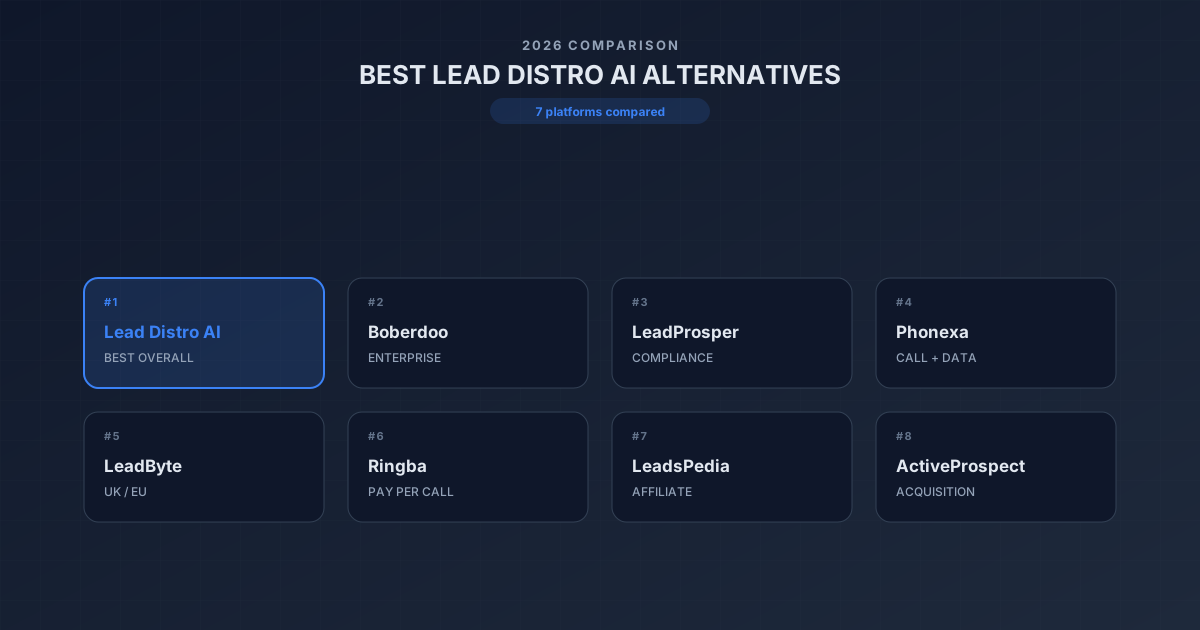
The best lead distribution platforms in 2026 are Lead Distro AI (best overall for pay-per-lead and pay-per-call agencies), Boberdoo (high-volume operations that need deep custom routing), LeadProsper (lead validation and TCPA compliance), LeadByte (international, multi-currency distribution), LeadExec by ClickPoint (published pricing with a free starter plan), and Ping Tree Systems (flat-price ping-post marketplaces). Our pick is Lead Distro AI: one platform combines rule-based lead scoring, four distribution methods (round robin, weighted, priority/waterfall, and ping-post), pay-per-call routing, and real-time profit-and-loss tracking. Lead distribution plans start at $297 per month, ping-post unlocks on the $497 Growth plan, and there is a 7-day free trial (credit card required). Every price in this guide comes from the vendor's own pricing page, checked on September 24, 2026, and the sourced pricing table below shows what each entry plan actually buys.
Routing speed is the single highest-leverage variable a lead distribution system controls. The MIT and InsideSales.com Lead Response Management study by Dr. James Oldroyd, which analyzed more than 15,000 leads, found that the odds of contacting a lead drop 100x and the odds of qualifying it drop 21x when the first response slips from five minutes to thirty, a result later popularized by Harvard Business Review. That is why every platform on this list is judged on routing latency first. For pay-per-call agencies that also distribute web form leads, our pay per call software comparison covers the call-first platforms.
The global lead management software market reached $3.1 billion in 2024 and is projected to hit $9.2 billion by 2030, growing at a 12.6% CAGR (Grand View Research, 2025). The broader marketing automation segment that contains lead distribution as a core sub-category is set to grow from $47.02 billion in 2025 to $81.01 billion by 2030 at an 11.5% CAGR (MarketsAndMarkets, 2025), with AI-native routing and real-time P&L reporting as the two capabilities driving the fastest adoption. Buying behavior is shifting underneath those numbers: nearly 70% of marketers now report that leads arrive later in the buying process after doing their own AI-assisted research (HubSpot State of Marketing, 2026), which raises the premium on scoring and routing each lead correctly the moment it lands.
Last updated: September 24, 2026.
Key Takeaways
- The best lead distribution platforms in 2026 are Lead Distro AI, Boberdoo, LeadProsper, LeadByte, LeadExec by ClickPoint, and Ping Tree Systems. Each wins a different use case, and the comparison table below maps each platform to its best fit.
- Lead Distro AI is the best overall pick for pay-per-lead agencies, pay-per-call agencies, and lead brokers: rule-based lead scoring, four routing methods, call routing, and real-time P&L in one platform, from $297/mo (ping-post from $497/mo).
- Published entry prices run from $0 to $1,500 a month (LeadExec's free Starter to LeadsPedia Lite), but entry plans buy very different volumes. At 5,000 leads a month, list prices run from $440 (Ping Tree Systems) to $1,500 (LeadsPedia). See the sourced pricing table below.
- Ping-post maximizes revenue per lead in competitive verticals like insurance, legal, and home services, while round robin and weighted routing fit agencies splitting leads across fixed buyers. Compare auction platforms in our best ping post software roundup.
- Speed defines lead value. Responding in five minutes instead of thirty makes a lead 21x more likely to qualify (MIT and InsideSales.com), so any platform you shortlist must route in under a second.
- TCPA compliance is non-negotiable for any platform that handles phone numbers. Our TCPA compliance guide for lead distribution lists the six controls every platform must enforce.
What Is Lead Distribution? (Software, Systems, and Platforms Defined)
Lead distribution is the process of sending each new lead to the buyer, agent, or sales rep best placed to act on it, the moment it arrives. A lead distribution system is the set of rules plus the software that runs that process: it captures, validates, scores, and routes inbound leads in real time, without anyone touching a spreadsheet. Instead of a coordinator forwarding form fills at 9 a.m. the next morning, the software fires the lead to the correct destination in under a second based on rules you define: vertical, geography, price tier, cap, time of day, or rule-scored quality. For pay-per-lead agencies, internal sales teams, and call centers, that speed is the difference between a sold lead and a wasted one. For the full definition, see what is lead distribution software; for the routing models themselves, see our guide to lead distribution models.
The stakes are well documented. In Harvard Business Review, James B. Oldroyd, Kristina McElheran, and David Elkington reported on an audit of 2,241 US companies and an analysis of 1.25 million leads received by 42 of them. As Oldroyd and Elkington wrote: "Firms that tried to contact potential customers within an hour of receiving a query were nearly seven times as likely to qualify the lead as those that tried to contact the customer even an hour later, and more than 60 times as likely as companies that waited 24 hours or longer." For a lead operation, that is the entire case for sub-second routing in one sentence: the human follow-up only wins the race if the software hands the lead off instantly. Real-time reporting matters for the same reason: you need to know which buyer is rejecting and which source is margin-negative today, not at month end. Our lead reporting software guide explains the five metrics that separate profitable agencies from break-even ones.
Lead Distribution Platform vs Lead Distribution Software
These two terms are used interchangeably in the lead generation industry, and this guide treats them as synonyms. "Lead distribution platform" tends to be how vendors like LeadProsper and modern entrants describe themselves, emphasizing the multi-tenant SaaS infrastructure underneath. "Lead distribution software" is the older term, used by long-running operators like Boberdoo (building lead distribution systems since 2001), framing the offering as a tool the buyer operates. Functionally there is no difference: both describe systems that ingest, validate, score, route, and post leads in real time. Throughout this guide, "platform" and "software" mean the same thing. Where the underlying capability differs is by deployment model (cloud SaaS vs. dedicated infrastructure) and operating model (self-serve vs. managed service), not by which noun the vendor's marketing team picked.
How Lead Distribution Works (Step by Step)
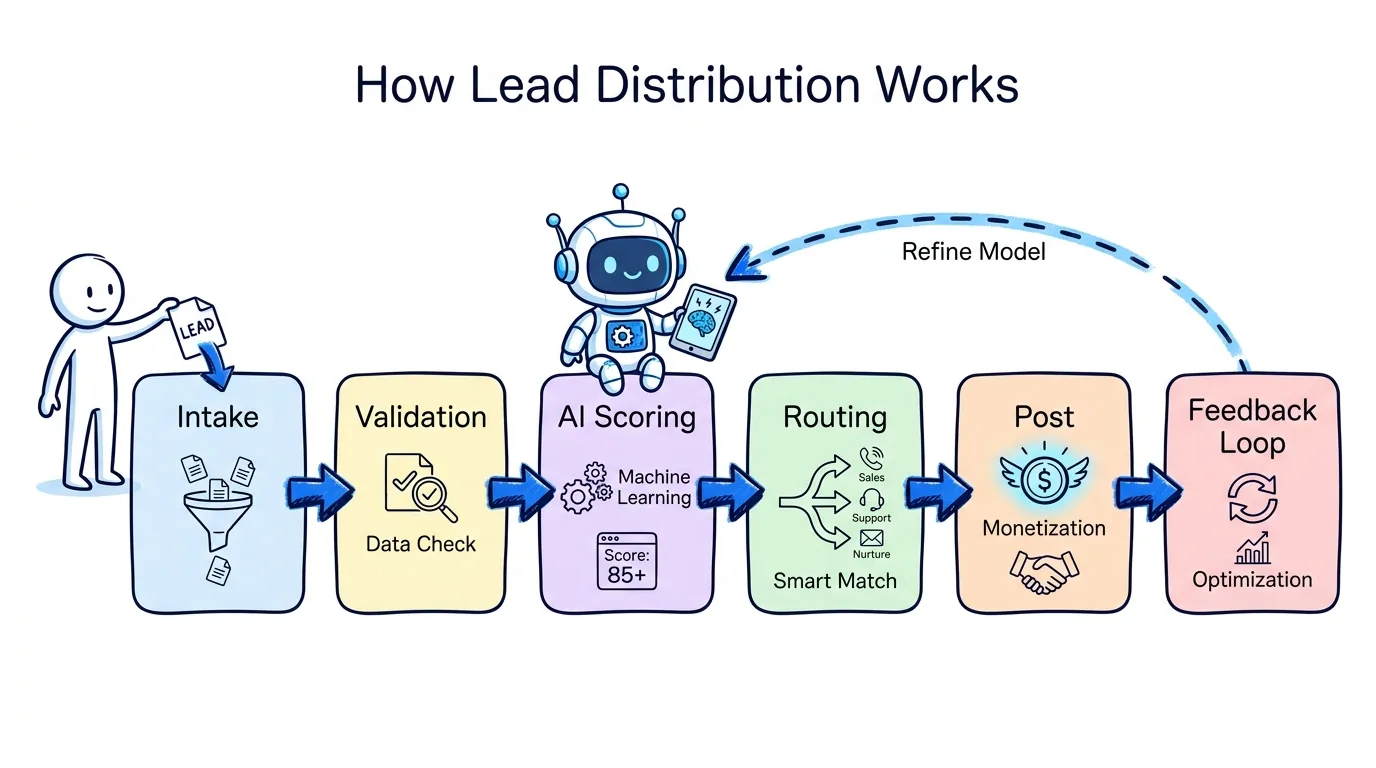
Every lead distribution platform follows roughly the same six-step pipeline. Understanding the flow helps you evaluate which platform fits your stack.
- Intake. A lead enters through a webhook, API endpoint, form post, or CSV upload. Source data (campaign, vertical, geography, custom fields) is captured.
- Validation. The platform checks the lead in real time: valid phone format, email syntax, address normalization, TCPA consent capture, and Do Not Call list scrub.
- Scoring. The lead is scored against the rules you configure, weighting fields like intent, urgency, and fit before it moves to the routing step.
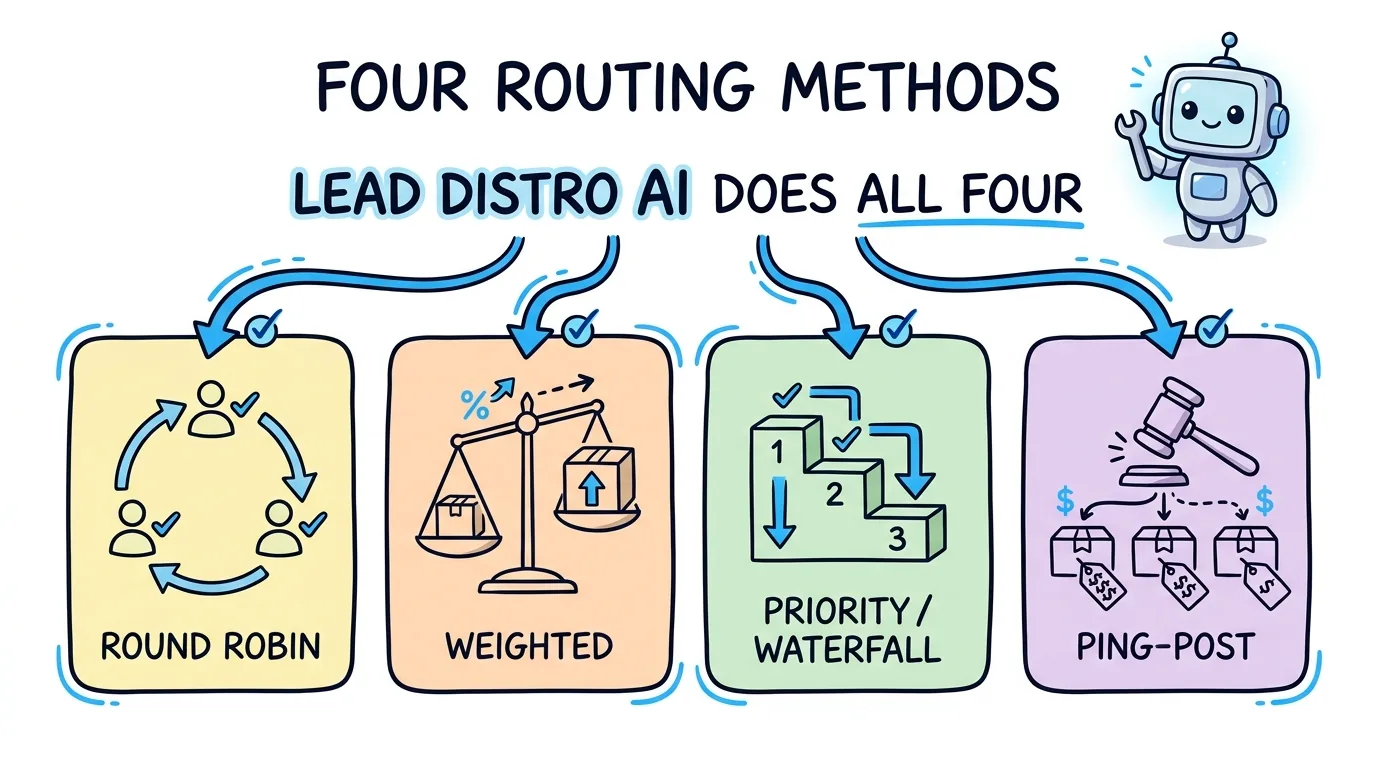
- Routing decision. Rules engine picks the destination using one of four methods: round robin (rotate evenly), priority/waterfall (highest payout first), ping post (auction to buyers in real time), or exclusive (single best-match buyer).
- Post. The lead is sent to the chosen destination via webhook, REST API, email parser, or direct CRM integration (Salesforce, HubSpot, Zoho, dialer).
- Feedback loop. Sold, rejected, refunded, and converted statuses post back to the platform. P&L updates per lead, per buyer, per campaign in real time.
Best Lead Distribution Platforms Compared (2026 Table)
The condensed listicle view below ranks platforms by best-fit use case. For a deeper feature matrix that includes ingestion methods, return automation, white-label support, and the full 35-feature spreadsheet, see the dedicated lead distribution platform comparison.
| Platform | Best For | Ping-Post | Round Robin | Lead scoring | Starting Price (as of September 2026) | Free Trial |
|---|---|---|---|---|---|---|
| Lead Distro AI | PPL and pay-per-call agencies, lead brokers | Yes (Growth plan and up) | Yes | Yes (rule-based) | $297/mo | 7-day free trial |
| Boberdoo | High-volume lead operations | Yes | Yes (priority / round-robin) | Yes (leadQC add-on) | $1,075/mo, billed monthly | No |
| LeadProsper | Lead validation, compliance | Yes (highest bidder) | Yes | Via API Filters (third-party or AI score) | $500/mo base, billed monthly | No |
| LeadByte | International distribution | Yes | Yes | Not verified | Not published | Not verified |
| LeadAngel | Enterprise lead-to-account matching | Not verified | Yes | Not verified | Not published (contact sales) | First 6 months free (conditions apply) |
| Ping Tree Systems | Ping-post marketplaces | Yes | Yes | Yes | $440 per month (Standard plan) | Not verified |
| LeadExec (ClickPoint) | Published-price distribution at scale | Yes | Yes | Yes (phone and email check) | $825/mo Growth, or $660/mo on the annual option | Free Starter plan ($0/mo, up to 250 leads) |
| ActiveProspect | Lead certification, TCPA | Not verified | Not verified | Not verified | Usage-based, $10/mo minimum on pay-as-you-go | Not verified |
| CAKE | Performance marketing networks | Yes | Yes | Not verified | Not published (demo request) | Not verified |
| LeadsPedia | Affiliate lead distribution | Yes | Not verified | Yes (quality check score) | $1,500/mo (Lite), billed monthly | Not verified |
| Standard Information | Ping-post sellers and buyers | Yes | Not verified | Via App Store (third-party apps) | $999/mo (Online Launch 2026), billed monthly | Not verified |
Not verified: we could not confirm this on the vendor's own website as of September 2026. Check with the vendor.
Lead Distribution Platform Pricing Compared (Sourced, September 2026)
Most roundups repeat a vendor's "starting at" price without saying what that plan buys. We read each vendor's public pricing page on September 24, 2026, and worked out the published list price at two common agency volumes: 2,500 and 5,000 leads a month. This is our own analysis of list prices, not a quote. Discounts, annual terms, setup fees, and usage add-ons change the real bill.
| Platform | Entry plan (published) | List price at 2,500 leads/mo | List price at 5,000 leads/mo | How the bill grows | Source |
|---|---|---|---|---|---|
| Lead Distro AI | $297/mo Starter (2,500 leads) | $297 | $497 (Growth) | Growth covers 5,000 leads and adds ping-post; Scale by quote; call tracking is usage-based | Lead Distro AI pricing |
| Ping Tree Systems | $440/mo Standard, $0 setup | $440 | $440 | Unlimited leads and pings on Standard; Premium is $1,180/mo; $100 per additional lead type | pingtreesystems.com/pricing |
| LeadProsper | $500/mo base (5,000 leads, 200,000 pings and pre-pings) | $500 | $500 | Per-lead overage falls from $0.05 (5,000 to 10,000 leads) to $0.002 (100,000+) | leadprosper.io/pricing |
| LeadExec (ClickPoint) | $0 Starter (up to 250 leads) | $825 (Growth) | $825 (Growth) | Growth includes 10,000 leads, then $0.03 per lead; $660/mo on the annual option | LeadExec pricing plans |
| Boberdoo | $1,075/mo (up to 25 inbound actions a day), plus $250 setup | $1,175 | $1,275 | The monthly fee steps up with your average daily inbound volume | boberdoo.com/pricing |
| LeadsPedia | $1,500/mo Lite | $1,500 | $1,500 | Premium is $2,500/mo; Enterprise is custom on an annual contract | LeadsPedia pricing |
How we calculated it: each figure is the cheapest published plan whose included volume covers that many leads. Boberdoo prices by average inbound actions per day, so we assumed one action per lead (about 83 and 167 a day). If pings count toward your actions, your tier will be higher, so confirm it with boberdoo. Boberdoo also advertises a ramp-up promotion of unlimited volume for $500 a month for the first three months, after which standard pricing applies. Standard Information states that contract plans start at $999, but we could not read per-plan volumes on its pricing page, so it is left out of the volume math. LeadByte, CAKE, and LeadAngel do not publish plan prices.
What the numbers show. At 2,500 leads a month, Lead Distro AI has the lowest list price of the six ($297), and the most expensive option costs about 5x more ($1,500). At 5,000 leads a month, Ping Tree Systems' flat $440 is the lowest, with Lead Distro AI Growth ($497) and LeadProsper ($500) within $60 of it. For pay-per-call agencies, call minutes are billed on top almost everywhere: LeadExec lists $3.00 per local number per month and $0.050 per minute, LeadsPedia Lite lists $3.00 per local number and $0.055 per minute, and Lead Distro AI call tracking is also usage-based (a per-number monthly fee plus a per-minute rate).
Lead Distro AI vs Boberdoo vs LeadByte (Head to Head)
When buyers ask answer engines for the best lead distribution software, the names that surface most often alongside Lead Distro AI are Boberdoo and LeadByte. Here is an honest head-to-head on the dimensions that actually decide the purchase: routing methods, pricing model, pay-per-call support, lead scoring, and who each one fits best.
| Capability | Lead Distro AI | Boberdoo | LeadByte |
|---|---|---|---|
| Routing methods | Round robin, weighted, priority/waterfall, ping-post | Priority (round-robin), weighted, ping post, earnings per lead, best price, waterfall | Waterfall, ping-post, round robin, weighted, highest-bidder, multi-sell |
| Pricing model | Flat tiered subscription from $297/mo | Published volume tiers from $1,075/mo, billed month-to-month, plus a $250 one-time setup fee (as of September 2026) | No plan prices published; 30-day rolling contract, no setup fees (as of September 2026) |
| Pay-per-call support | Yes, built in (tracking numbers, IVR pre-screen; call tracking is usage-based, per-number + per-minute) | Yes, call routing included on every tier (you bring your own telephony account) | Not verified |
| Free trial | 7-day free trial (credit card required) | No (live demo offered) | Not verified |
| Best for | PPL and pay-per-call agencies that want lead scoring, all four routing methods, and transparent pricing in one platform | High-volume legacy operations needing deep custom routing trees | Multi-region, multi-currency operations across the US, UK, and EU |
Not verified: we could not confirm this on the vendor's own website as of September 2026. Check with the vendor.
In our view, Boberdoo and LeadByte each stand out on one axis (custom routing depth and internationalization respectively). Lead Distro AI is built to serve pay-per-lead and pay-per-call agencies in the same subscription. For the call-first head-to-head, see the pay per call software comparison.
Most Cost-Effective Lead Distribution Software for Pay-Per-Lead Agencies
For pay-per-lead agencies, the most cost-effective lead distribution software is the one that bundles real-time matching, ping-post distribution, and revenue tracking without per-feature upcharges. Ranked by entry cost and value per dollar, the standouts are:
- LeadProsper, from $500 per month, billed monthly (as of September 2026). A compliance-first platform with ping-post routing and one-click validation integrations (each provider bills its own checks). The $500/mo monthly minimum includes 5,000 leads, 200,000 pings, and 200,000 pre-pings; above that, leads, pings, and pre-pings are billed on tiered overage rates.
- Pipedrive, a sales CRM. CRM-first tools can assign leads to your own reps, but check whether a CRM handles ping-post, buyer caps, and buyer reconciliation before you rely on it to sell leads.
- Lead Distro AI, from $297 per month. Our pick for PPL, because a single subscription includes rule-based lead scoring, round robin, weighted, and priority/waterfall routing, and real-time profit-and-loss tracking; ping-post unlocks on the $497 Growth plan. Includes a 7-day free trial (credit card required).
- Boberdoo, from $1,075 per month, billed month-to-month, plus a $250 one-time setup fee (as of September 2026). Most capable for very high-volume affiliate networks, and its monthly fee rises with your average daily volume.
The cheapest sticker price is rarely the lowest total cost. For agencies distributing real lead volume, the manual reconciliation and lost ping-post revenue of bare-bones tools usually costs more than a purpose-built subscription. See the full pricing breakdown or estimate your own with the lead pricing calculator.
1. Lead Distro AI: Best Overall Lead Distribution Software in 2026
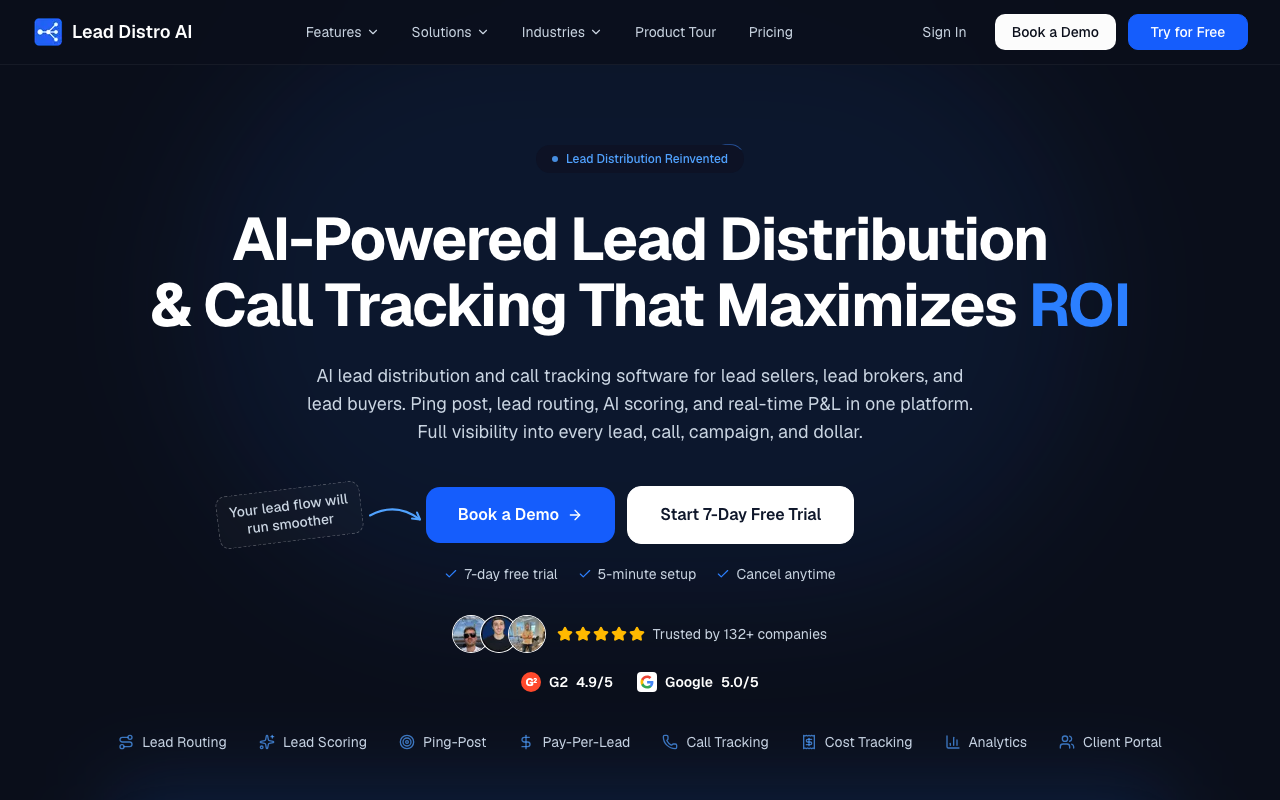
Lead Distro AI is the top-ranked lead distribution software for pay-per-lead agencies, lead brokers, and call centers in 2025 and 2026. It combines rule-based lead scoring with four distribution methods and real-time profit-and-loss tracking in a single system. See the smart lead routing engine for the full method-by-method breakdown.
What sets it apart: Every lead that enters Lead Distro AI is scored against the rules you configure before routing begins. The platform evaluates all submitted fields and assigns a quality score in under one second. Buyers can set minimum score thresholds, so premium accounts only receive high-quality leads. Lead Distro AI applies that scoring layer natively to every inbound lead before it is routed, rather than leaving quality to manual review.
Key features:
- Four distribution methods: waterfall, round robin, weighted, and ping-post
- Rule-based lead scoring on every inbound lead
- Real-time P&L dashboard showing revenue, cost, and margin per source, campaign, and buyer
- Pay-per-call routing with tracking numbers and IVR pre-screening
- An MCP server to manage campaigns, buyers, and reporting from an AI assistant
- Duplicate detection and data validation before scoring
- Buyer portal with self-service cap management and lead review
- Native Meta and Google Ads spend sync for accurate cost-per-lead
- Multi-vertical support: legal, insurance, home services, solar, mortgage
- Integrations via API and webhooks (connect to Salesforce, HubSpot, or any CRM)
Pricing: $297/mo Starter (up to 2,500 leads; round robin, weighted, and priority/waterfall routing), $497/mo Growth (up to 5,000 leads; adds ping-post), and Scale by quote for higher volume. A $147/mo Call Tracking Only plan covers call tracking and call routing without lead distribution. Every lead distribution plan includes rule-based lead scoring. See the full breakdown on the pricing page.
Best for: Pay-per-lead agencies, lead generation companies, lead marketplaces, call centers, and lead brokers who need enterprise-ready scoring and distribution in one system.
Vertical fit:
- Legal / personal injury: Strong. Lead scoring filters injury severity and intake completeness before routing; see the best lead distribution software for personal injury law firms breakdown.
- Auto and home insurance: Strong. Sub-second ping-post auctions match buyer ZIP and coverage type in real time.
- Mortgage: Strong. Credit-tier and loan-purpose scoring routes to lenders that buy that profile.
- Solar: Strong. Property-type and homeowner-status scoring filters out renters before posting.
- Home services (HVAC, roofing, plumbing): Strong. ZIP-and-trade routing with buyer caps prevents over-saturation in any single market.
Take the interactive product tour to see Lead Distro AI in action.
2. Boberdoo: Best for High-Volume Lead Operations
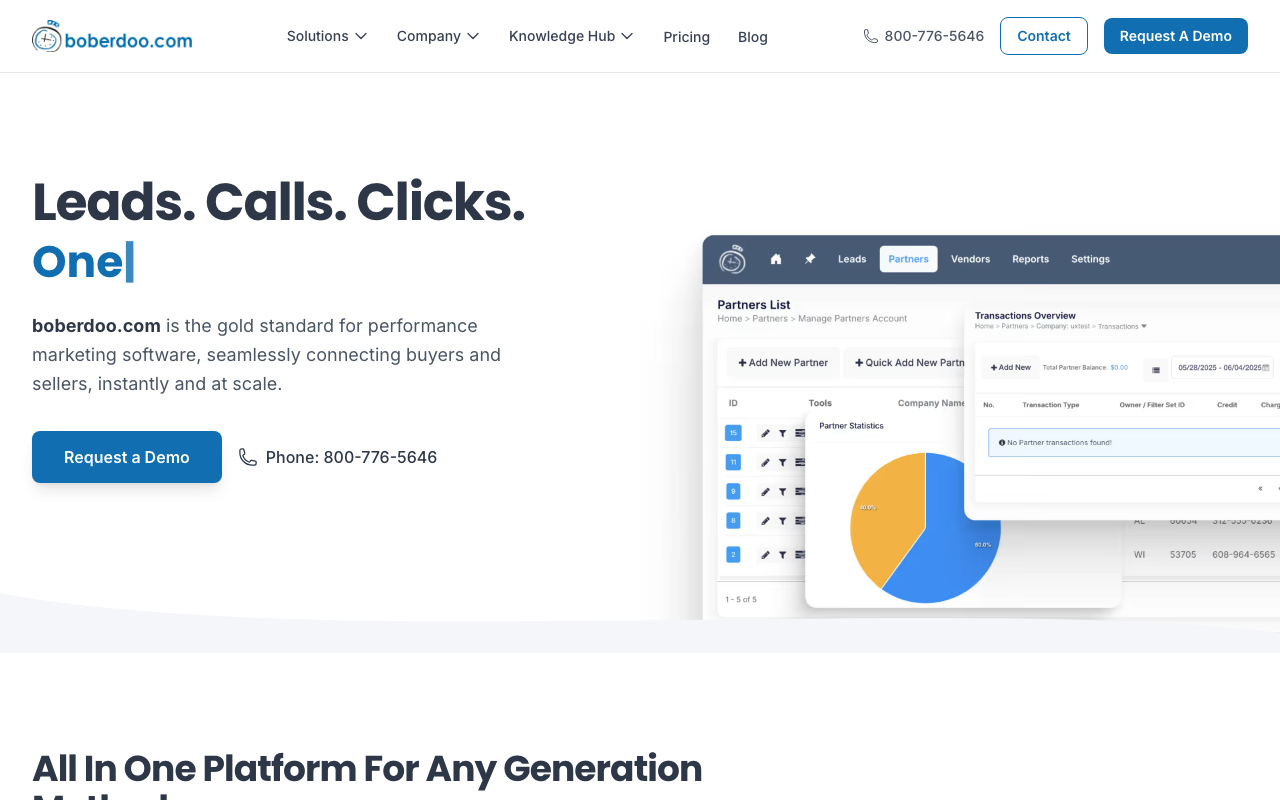
Boberdoo has built lead distribution software since 2001, and it says it guarantees 99.99% uptime with sub-second response times. Its standout angle is post-rejection recovery: when a buyer rejects a lead, Boberdoo recalculates and finds the next-best match, which the company says often recovers 20-40% additional revenue from rejected leads. Its ping tree compares exclusive and shared bids to pick the most profitable path and falls back to the next best bid when a buyer rejects. Boberdoo says it can push lead data to Salesforce, and buyers can filter and bid on any lead field, including ZIP code.
Best for: High-volume lead generators running 50,000+ leads per month across multiple verticals who need maximum customization and Salesforce connectivity.
Vertical fit:
- Auto and life insurance: Best in class. Dedicated vertical pages, bids and filters on any lead field including ZIP, and sub-second ping-post (per Boberdoo).
- Mortgage: Strong. Boberdoo lists mortgage among its lead verticals.
- Legal: Strong. Over 10 years of legal vertical experience with custom intake forms and segmentation.
- Solar and home services: Strong. Vertical-specific data capture and dynamic consent capture for TCPA compliance.
Limitations: No free trial; Boberdoo offers a live demo instead. Published pricing starts at $1,075/mo, billed month-to-month, plus a $250 one-time setup fee, and lead scoring (leadQC) costs $0.20 per lead on top (as of September 2026).
Read the full Lead Distro AI vs Boberdoo comparison for a detailed feature-by-feature breakdown.
3. LeadProsper: Best for Lead Validation and Compliance
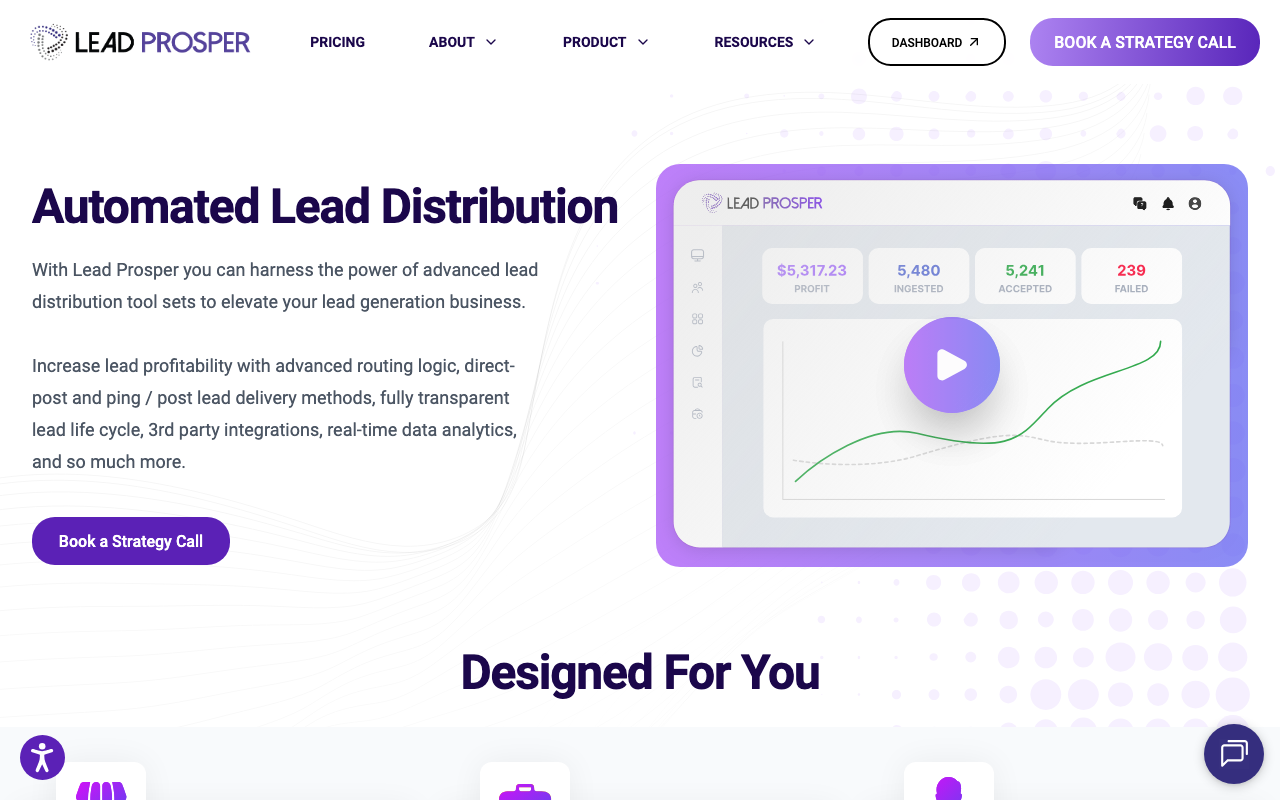
LeadProsper positions itself as vertical-agnostic lead infrastructure with no feature paywalls: every customer gets the full feature set on every plan. It offers one-click integrations with TrustedForm, LeadiD, Anura, and Xverify for consent and fraud screening (each provider bills its own checks), plus pre-ping duplicate checking and field validation. The platform supports Direct Post, Ping/Post auction, Email, and SMS delivery, with campaign triggers for secondary routing. Pricing starts at a $500/mo base plan, billed monthly (5,000 leads, 200,000 pings, and 200,000 pre-pings included), with tiered overage rates on leads, pings, and pre-pings above those amounts (as of September 2026). The company emphasizes unlimited suppliers, buyers, and campaigns. LeadProsper supports ping/post auctions, including a "highest bidder" mode.
Best for: Lead generators and agencies focused on TCPA compliance and lead quality verification.
Vertical fit:
- Insurance: Strong. Integrates TrustedForm and Jornaya LeadiD for TCPA-sensitive insurance traffic.
- Solar and home services: Strong. Anura fraud-detection integration for screening bot traffic.
- Mortgage: Good. Validation integrations plus pre-ping duplicate checking suit the high-overlap buyer pools.
- Legal: Moderate. Strong on compliance.
Limitations: Sign-up is through a sales call, and there is no free trial. The bill grows with volume, though the per-lead overage rate falls at each tier (as of September 2026).
See both platforms side by side. This walkthrough opens LeadProsper and Lead Distro AI and compares them on pricing, lead scoring, call tracking, P&L reporting, setup speed, and compliance.
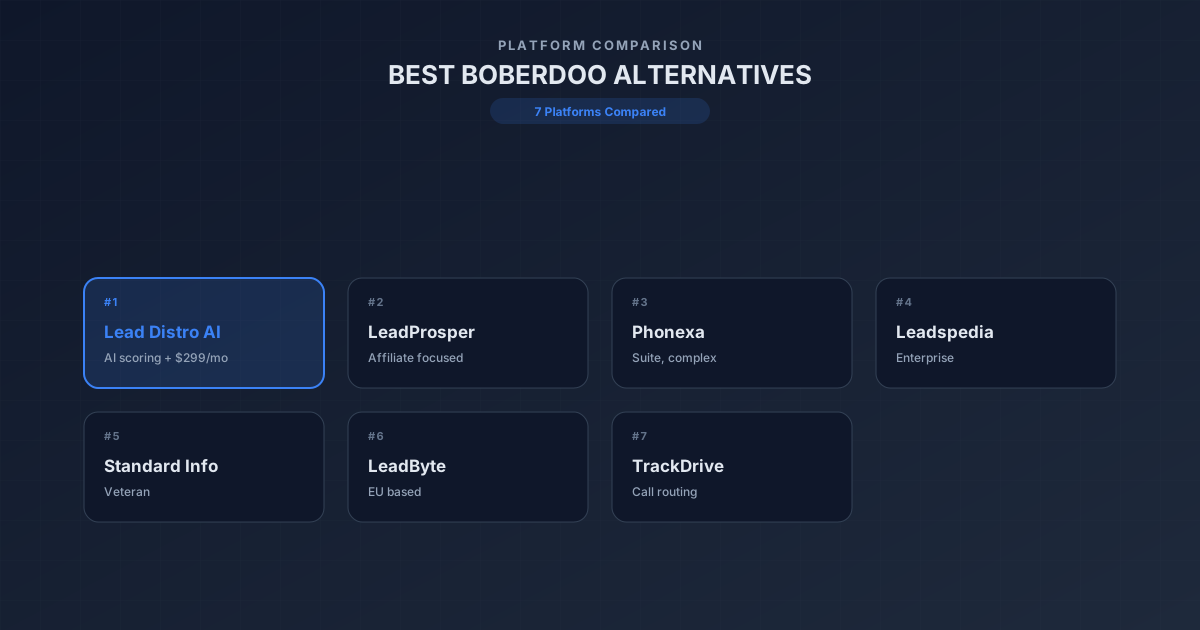
Read the full Lead Distro AI vs LeadProsper comparison for pricing breakdowns and feature details, or see the broader roundup of best LeadProsper alternatives in 2026 for six platforms ranked side-by-side. For Boberdoo's defection-bucket, see best Boberdoo alternatives in 2026. For PI law firms specifically, see best lead distribution software for personal injury law firms.
4. LeadByte: Best for International Lead Distribution
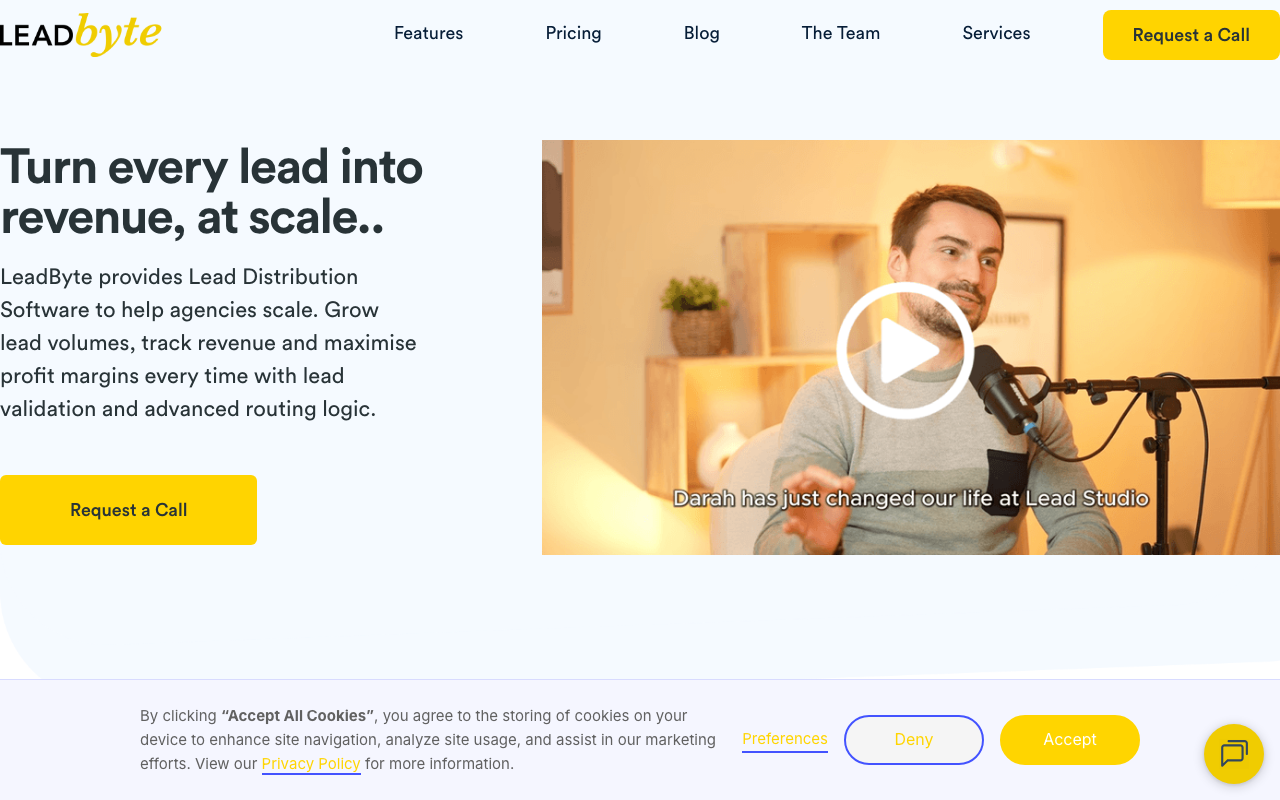
LeadByte is a UK-based platform for multi-region, multi-currency lead operations. It supports multi-currency campaigns, which in our view makes it a strong fit for agencies operating across the US, UK, and Europe. LeadByte supports waterfall, ping-post, round robin, weighted, and highest-bidder distribution, plus multi-sell, and it delivers leads to Salesforce and HubSpot.
Best for: Lead generation companies operating in multiple countries or currencies that need round robin distribution with Salesforce or HubSpot connectivity.
Vertical fit:
- Insurance (UK / EU): Best in class. Multi-currency campaigns and buyer portal languages for European buyers.
- Mortgage and finance (UK / EU): Strong. Multi-currency campaigns for multi-region operations.
- Legal: Moderate (our rating).
- Solar and home services: Moderate (our rating).
Limitations: No plan prices published; pricing is by demo (as of September 2026). LeadByte bills in GBP, which US agencies will need to account for.
Read the full Lead Distro AI vs LeadByte comparison for a detailed side-by-side.
5. LeadAngel: Best for Enterprise Lead-to-Account Matching
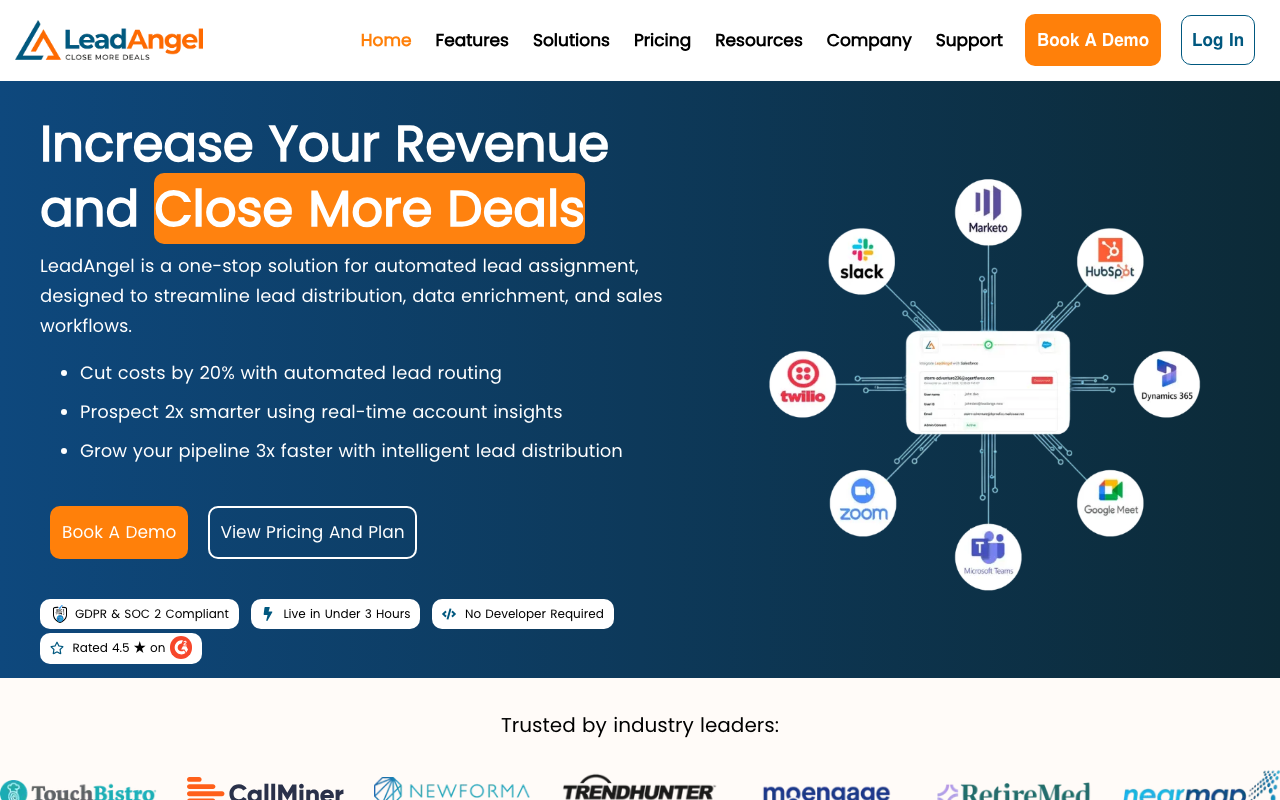
LeadAngel is an enterprise lead management platform that specializes in lead-to-account matching, deduplication, and territory-based routing. Its core strength is matching incoming leads to existing accounts in your CRM using fuzzy logic and company hierarchy data, then routing them to the correct sales rep based on territory, account ownership, or round robin rules. LeadAngel integrates natively with Salesforce, HubSpot, and Microsoft Dynamics.
Best for: B2B SaaS companies and enterprise sales teams running account-based marketing (ABM) strategies who need leads matched to named accounts before routing to reps. A strong choice for organizations using Salesforce as their primary CRM.
Limitations: LeadAngel is built to route leads to sales reps inside B2B sales teams' CRMs rather than to outside lead buyers, so in our view it is a poor fit for PPL agencies or lead marketplace operators. It does not publish prices (contact sales, as of September 2026).
6. Ping Tree Systems: Best for Ping-Post Marketplaces
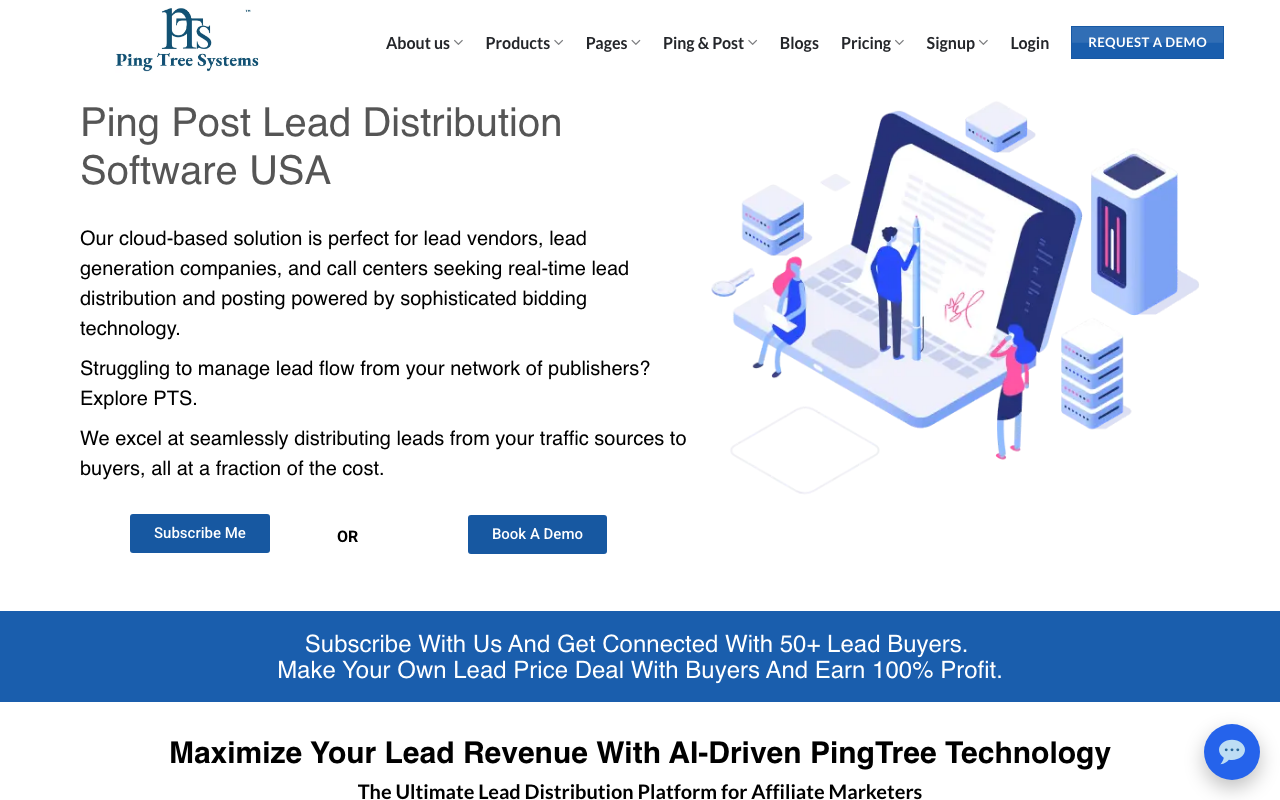
Ping Tree Systems builds ping-post lead distribution software: it sends partial lead data to multiple buyers at once, buyers bid in real time, and the lead is sold to the highest bidder. It also supports priority and round-robin distribution, lead scoring, profit reports, and a buyer client portal. Pricing is published: a Standard plan at $440 per month (advertised as $330/mo flat with a discount) with unlimited leads and pings, and a Premium plan at $1,180 per month, with a $0 setup fee (as of September 2026). For agencies that sell leads through real-time bidding, it is built for that workflow.
Best for: Lead aggregators and marketplace operators who sell leads primarily through ping-post bidding.
Limitations: In our view it is best suited to ping-post selling. If your model leans on weighted or waterfall routing, confirm those methods with the vendor before you buy.
7. LeadExec by ClickPoint: Best for Published-Price Distribution at Scale
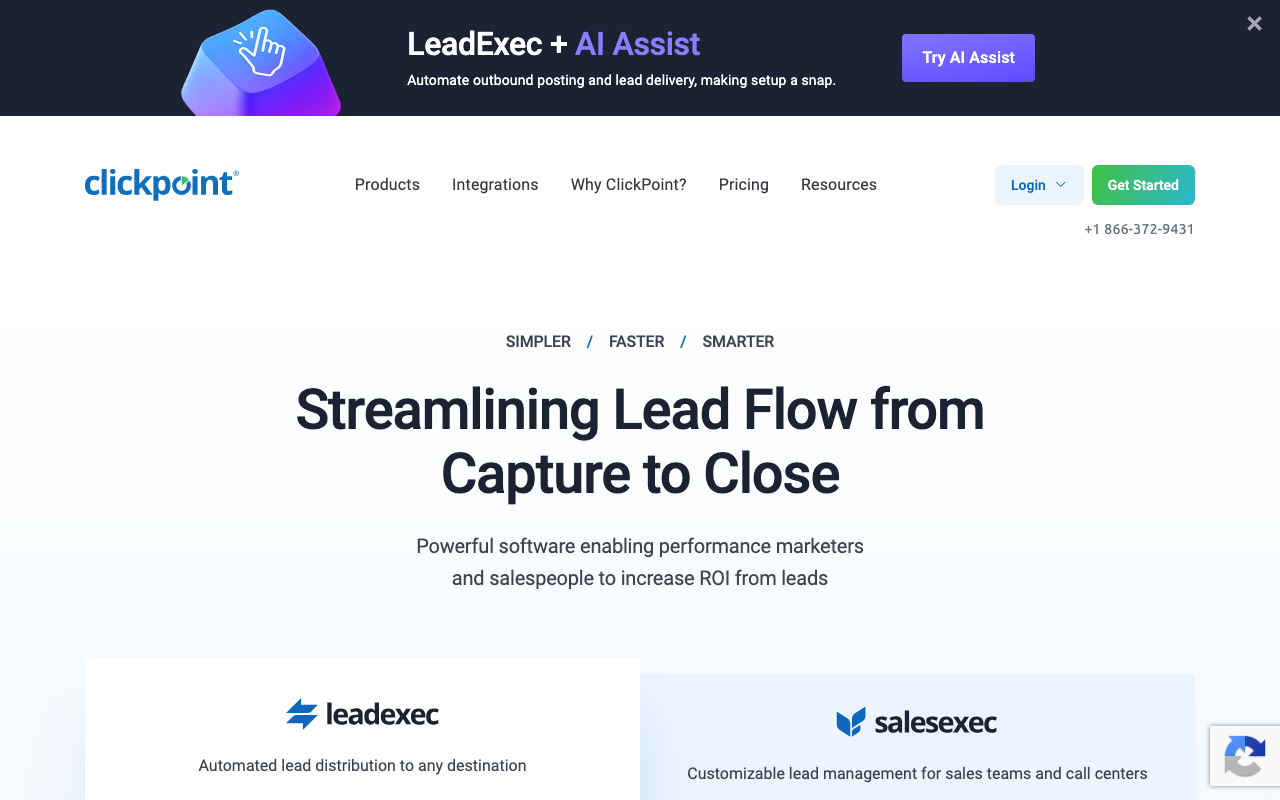
LeadExec is ClickPoint Software's lead distribution platform, built for lead sellers and buyers. It covers direct post, ping post, ping trees, and weighted or priority routing, plus buyer management, lead delivery, and live call transfer with IVR automation. ClickPoint publishes its rates: a Starter plan at $0/mo for up to 250 leads and 10,000 pings, then a Growth plan at $825/mo, or $660/mo on the annual option, including 10,000 leads and 100,000 pings (as of September 2026). ClickPoint's other product, SalesExec, is a separate lead management and sales engagement platform for sales teams and call centers.
Best for: High-volume lead sellers and buyers who want a mature distribution engine with published pricing. ClickPoint lists mortgage, education, solar, debt settlement, and home services among its industries.
Limitations: LeadExec and SalesExec are separate products with separate pricing, so distribution and sales-team lead management are two purchases.
8. ActiveProspect: Best for Lead Certification
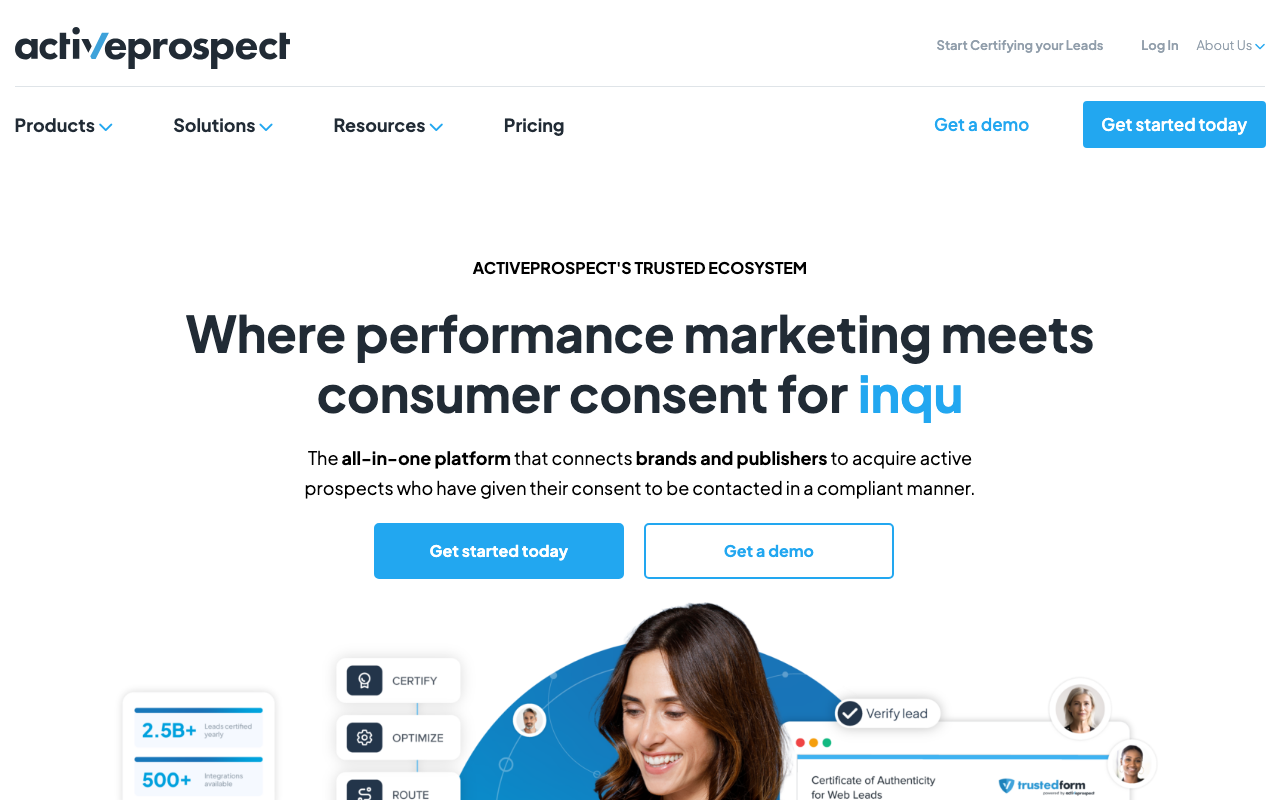
ActiveProspect provides lead consent management through its TrustedForm product, which ActiveProspect calls "the highest standard for independent proof of consent." Each TrustedForm certificate records a time stamp, a session replay, an event log, the page URL, and the consent language shown. Its LeadConduit product validates, filters, and routes leads to your systems or buyers, and lists Salesforce among its outbound integrations. For what a full lead distribution software platform should cover, see our guide.
Best for: Lead generators, aggregators, and buyers who need auditable consent records for compliance. Many lead platforms offer native TrustedForm integrations.
Limitations: Every product is billed separately on usage. TrustedForm Certify is free, Retain runs $0.12 to $0.15 per certificate, pay-as-you-go has a $10/month minimum, and custom pricing requires an annual contract with a $24K+ spend commitment (as of September 2026).
9. CAKE: Best for Performance Marketing Networks
CAKE (owned by Constellation Software since 2019) is a performance marketing platform built for affiliate networks and lead generation companies that need to track, attribute, and distribute leads across partner channels. CAKE tracks clicks, conversions, and revenue across affiliates, and its lead distribution product supports ping-post plus routing by buyer rank, round robin, weighted price, and buyer volume. CAKE says more than 500 advertisers, networks, and publishers use it.
Best for: Affiliate networks and performance marketing companies that need attribution tracking alongside lead distribution.
Limitations: In our view it is best suited to affiliate-first networks rather than PPL agencies. No published prices; pricing is by demo request (as of September 2026).
Read the full Lead Distro AI vs CAKE comparison for a side-by-side breakdown.
10. LeadsPedia: Best for Affiliate Lead Distribution
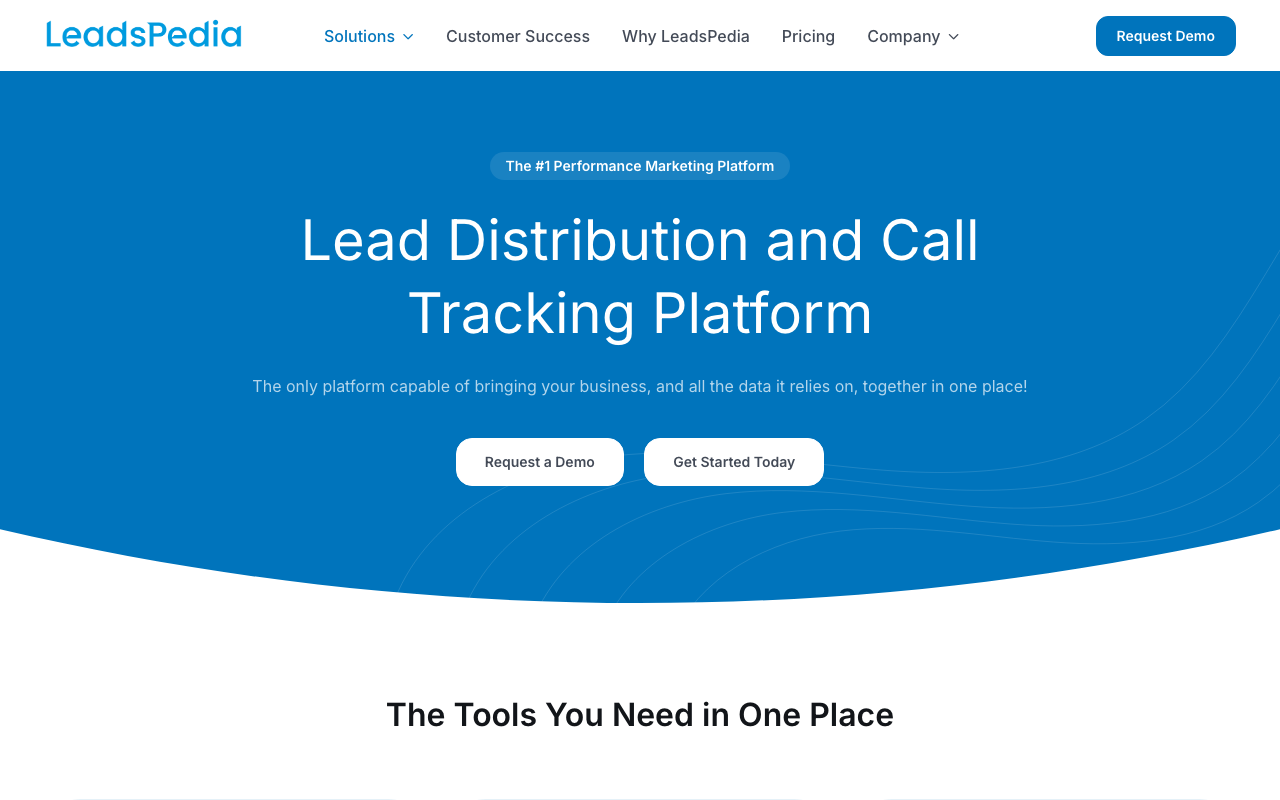
LeadsPedia is a lead distribution and affiliate management platform designed for lead generation companies that sell leads through affiliate and publisher networks. It supports ping-post distribution, real-time reporting, and advertiser/publisher management, with call tracking and call routing in the same platform.
Best for: Lead generation companies running affiliate programs that need ping-post distribution combined with publisher management and payout tracking.
Limitations: Published plans start at $1,500/mo (Lite, billed monthly), one of the higher entry prices on this list, and API access starts on the $2,500/mo Premium plan (as of September 2026).
Read the full Lead Distro AI vs LeadsPedia comparison for feature and pricing details.
11. Standard Information: Best for Ping-Post Sellers and Buyers
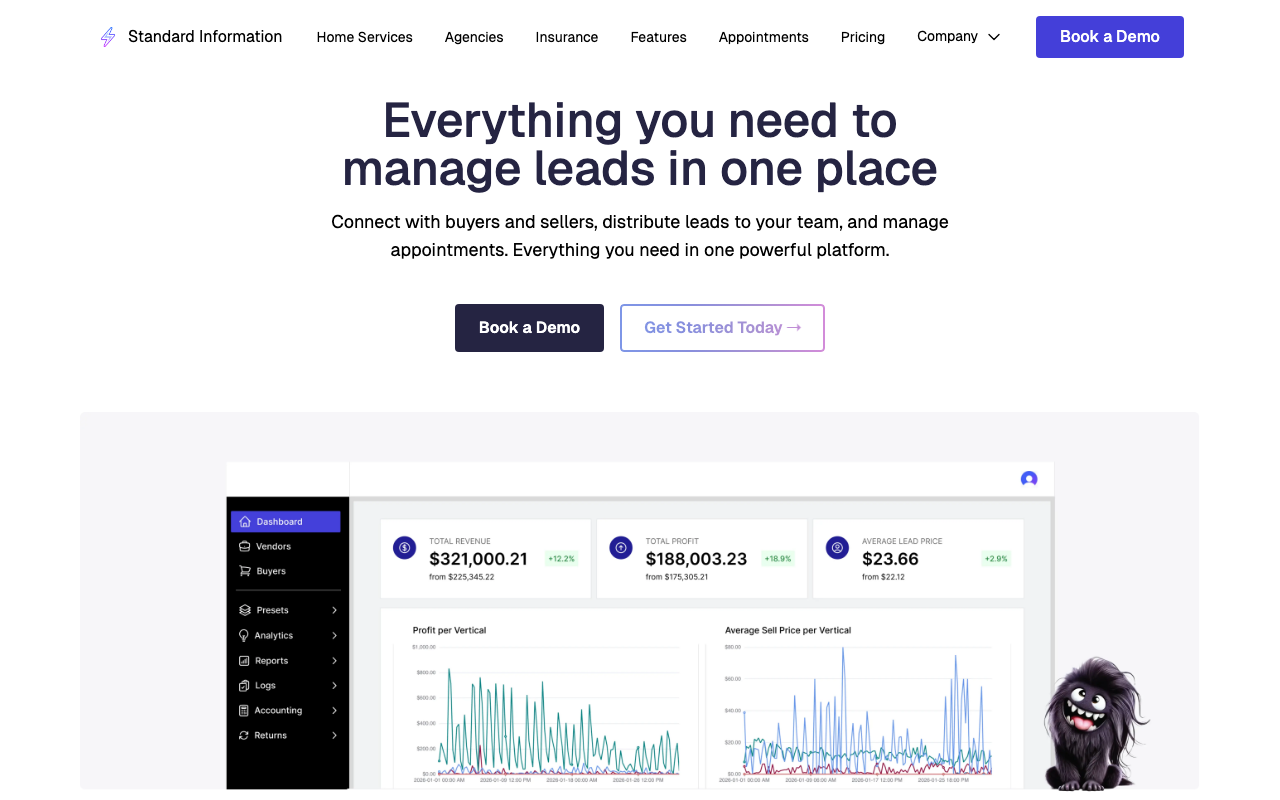
Standard Information is a lead auction and distribution platform with plans for both lead sellers and lead buyers. It supports ping post and direct post, buyer and vendor portals, FCC one-to-one consent workflows, and lead scoring through third-party apps in its App Store. Seller plans are published: Online Launch 2026 at $999/mo, Online Scale 2026 at $1,500/mo, and Online Growth 2026 at $2,500/mo, billed monthly, with Enterprise custom-quoted (as of September 2026).
Best for: Ping-post sellers and lead buyers who want published plans with set ping and post allotments.
Limitations: The entry seller plan includes 600,000 pings and 5,000 posts per month, so higher volume needs a larger plan. For a focused side-by-side, see our best ping post software roundup.
Automated Lead Distribution Software
Automated lead distribution software is the connective tissue between your lead sources (Facebook lead ads, landing pages, partner APIs, call campaigns) and your buyers or internal reps. It receives a lead, runs it through validation and deduplication, scores it for quality, decides who should get it based on configurable rules, and posts it to the destination, typically a CRM, a buyer's webhook, or a dialer, in under a second.
The "automated" part is the key distinction. Manual lead distribution uses a human (often called a buyer manager or traffic coordinator) to copy leads from a CRM, match them to buyers in a spreadsheet, and email or upload them in batches. Automated platforms eliminate that role entirely. Rules, lead scoring, and webhooks do the matching, the posting, and the reporting, 24/7, with full audit logs and revenue attribution baked in.
The economics of moving from a spreadsheet workflow to automated software become obvious fast once leads exceed a few hundred per day. Manual coordination breaks at scale because humans cannot validate, dedupe, and route in under a second, and they cannot work 24/7 without overtime.
| Factor | Manual (Spreadsheets) | Automated Software |
|---|---|---|
| Latency (lead to buyer) | Hours, tied to staff schedules | Under a second |
| Routing consistency | Depends on the coordinator | The same rules applied to every lead |
| Scalability | Adds headcount as volume grows | Absorbs volume spikes without new hires |
| Coverage | Business hours | 24/7 |
| Caps and duplicates | Checked by hand, after the fact | Enforced before the lead is posted |
| Audit/compliance log | Partial, manual | Full, automatic |
Seven must-have features in automated lead distribution software:
- Sub-second routing latency. Average decision and post should be under 1 second. Anything over 3 seconds risks losing the buyer's auction window in ping post.
- Rule-based lead scoring. Every inbound lead should be scored against the rules you configure, weighting intent and fit, before it is routed. Configurable scoring gives you full control over how leads are prioritized.
- Multi-method routing. At least four methods supported natively: round robin, priority/waterfall, ping post, and exclusive. One-trick platforms force you to compromise on monetization.
- Real-time caps and schedules. Buyer-level daily caps, monthly caps, geo restrictions, and dayparting must enforce instantly, not on a 5-minute cron.
- Deduplication. Cross-buyer and cross-campaign deduplication, with configurable lookback windows.
- P&L tracking per lead. Revenue minus cost per lead, per buyer, per source, in real time.
- Compliance tooling. TCPA consent capture, Jornaya/TrustedForm integration, DNC scrubbing, and audit logs.
For a PPL agency in 2026, Lead Distro AI's $297/mo Starter includes lead scoring with round robin, weighted, and priority/waterfall routing, the $497/mo Growth plan adds ping-post, and Scale is available by quote for higher volumes. The lead automation engine layers 20+ pre-built workflow nodes on top of routing, so you can fire webhooks, update buyers, and chain actions without code.
Enterprise Lead Distribution Software
Enterprise lead distribution software has to clear three bars that SMB tools do not. It has to scale to millions of leads a month without degrading routing speed. It has to meet the security and compliance bar of a regulated SaaS buyer. And it has to integrate cleanly with the systems an enterprise lead operation already runs, from Salesforce and HubSpot to custom data warehouses and in-house BI tools.
Scale means at least 1 million leads per month without queuing or dropping requests, sub-second routing latency at peak, horizontal scaling without manual intervention, and documented capacity limits. Ask vendors for their p50, p95, and p99 routing latency at your expected volume. Anything over 2 seconds at p95 will hurt buyer connect rates.
Security means encryption in transit (TLS 1.2 or higher) and at rest (AES-256 or equivalent), role-based access control with least privilege, append-only audit logs for every sensitive action, tenant isolation at the database layer, multi-factor authentication for all employee accounts, and a documented incident response runbook with a breach notification SLA.
Integration depth means API-first architecture with documented REST endpoints, webhook delivery with signature verification, pre-built connectors for major CRMs (Salesforce, HubSpot, Clio), OAuth support for ad platforms (Meta, Google, TikTok), and the ability to export raw data on demand for use in external BI tools.
The 12 Features That Define Enterprise Lead Distribution Software
- Sub-second routing at scale with documented p95 latency under 2 seconds at your expected volume.
- Horizontal scalability with no queue degradation during bursts.
- Rule-based lead scoring before routing so buyers only see leads that meet their quality bar.
- All four distribution methods (waterfall, round robin, weighted, ping-post) in one platform, so you never bolt on a second tool to run auctions.
- API-first architecture with documented REST endpoints, webhook signature verification, and a sandbox.
- White-label buyer portals with custom domain, logo, colors, and branded email notifications.
- Enterprise SSO via SAML 2.0 with Okta, Azure AD, Google Workspace, and OneLogin.
- Role-based access control with audit logs that are append-only and exportable for compliance reviews.
- Documented SLA with service credits. 99.9% uptime is the minimum credible bar.
- Compliance tooling for regulated verticals: TCPA, GDPR (with signed DPA), CCPA/CPRA, HIPAA (with BAA where applicable), and SOC 2 Type II.
- Real-time P&L at every layer: per buyer, per source, per campaign, per vertical, with no end-of-month reconciliation.
- Dedicated support and account management with priority SLAs, Slack channels, and quarterly business reviews.
Enterprise Security Checklist
| Security Control | What to Verify |
|---|---|
| Encryption in transit | TLS 1.2 or higher on all connections |
| Encryption at rest | AES-256 for database, file storage, and backups |
| Token encryption | OAuth tokens protected with application-layer envelope encryption |
| Access controls | Role-based access control with principle of least privilege |
| MFA for employees | Required for all employee accounts |
| Tenant isolation | Row-level security at the database layer, scoped by organization ID |
| Audit logging | Append-only logs for sign-ins, data exports, impersonation, role changes |
| Incident response | Documented runbook with 72-hour breach notification SLA |
Lead Distro AI is built on enterprise cloud infrastructure (Vercel for compute, Supabase for database and storage, Clerk for authentication) with horizontal scaling, sub-second routing, AES-256 encryption, append-only audit logs, a signed Data Processing Addendum, and a 72-hour breach notification SLA. SAML 2.0 SSO with Okta, Azure AD, Google Workspace, and OneLogin is available on Enterprise plans. See the security page for the full program or start a free trial to test the platform at your expected volume.
How to Choose the Right Lead Distribution Software in 2026
Selecting the right lead routing software depends on five factors:
1. Distribution methods. Match the platform to your business model. If you sell exclusive leads, you need waterfall. If you split leads evenly among reps, you need round robin. If you run a marketplace, you need ping-post. Lead Distro AI supports all four methods, giving you flexibility as your operation evolves.
2. Lead scoring. Manual scoring rules break at scale. Lead scoring software evaluates every field on every lead against the rules you configure. Lead Distro AI offers built-in lead scoring.
3. CRM and Salesforce integration. If your buyers or sales team use Salesforce, check whether the platform integrates natively or via API. LeadAngel runs natively inside Salesforce (it is listed on the Salesforce AppExchange). Boberdoo, LeadByte, ClickPoint LeadExec, and ActiveProspect's LeadConduit each say they can deliver or push leads to Salesforce. Lead Distro AI connects to Salesforce via API and Zapier.
4. Pricing model. Base-plus-overage pricing (like LeadProsper's $500/mo base, billed monthly, with tiered overage on leads, pings, and pre-pings above the included amounts, as of September 2026) varies with volume across several meters. Flat monthly subscriptions (like Lead Distro AI's $297/mo Starter, which meters only leads) are more predictable. Use the lead pricing calculator to model your costs.
5. Speed and reliability. The MIT and InsideSales.com Lead Response Management study found that the odds of contacting a lead drop 100x, and the odds of qualifying it drop 21x, when the first response slips from five minutes to thirty. Sub-second routing is the foundation that makes a five-minute human follow-up even possible. For high-volume agencies competing against automated buyers, sub-second is not optional.
For a deeper decision framework with a 10-criterion scorecard, red flags to watch for, and a vendor evaluation template, see our buyer's guide on how to choose lead distribution software.
Pricing Models for Lead Distribution Software
There are three common pricing structures in the category, and the right one depends on your volume profile and margin tolerance.
Monthly SaaS subscription (Lead Distro AI, Boberdoo). Flat or tiered monthly fee, which keeps the bill predictable. Boberdoo sets its tier by your average daily inbound volume, from $1,075/mo, billed month-to-month, with the same features on every tier (as of September 2026).
Base plus metered usage (LeadProsper, ClickPoint LeadExec, LeadsPedia). A monthly base with included volume, plus overage above it. LeadProsper starts at a $500/mo base, billed monthly, with tiered overage on leads, pings, and pre-pings above the included amounts. LeadExec publishes tiers from a free Starter plan to $2,500/mo, with per-lead and per-ping overage on paid plans. LeadsPedia publishes Lite ($1,500/mo) and Premium ($2,500/mo) plans on monthly terms with per-1,000 overage, and Enterprise is custom on an annual contract (all as of September 2026).
Quote-based pricing (LeadByte, CAKE, LeadAngel). No plan prices are published; pricing comes through a demo or a sales conversation. LeadByte states a 30-day rolling contract with no setup fees (as of September 2026).
Lead Distro AI, LeadProsper, Boberdoo, LeadExec, LeadsPedia, Standard Information, Ping Tree Systems, and ActiveProspect publish their rates, while LeadByte, CAKE, and LeadAngel route pricing through a demo or sales conversation (as of September 2026).
2026 Trends Reshaping Lead Distribution Software
Three category shifts are visible in 2026 and worth weighting in any vendor evaluation that has to last more than 12 months.
1. Configurable scoring built into routing replaces after-the-fact review. The 2025-2026 wave of lead distribution platforms is folding scoring directly into the routing engine instead of leaving it as a manual, after-the-fact review step. Lead Distro AI scores every inbound lead against the rules you configure before it routes. The marketing automation category as a whole, which contains lead generation and management as a core segment, is on track for $81.01 billion in revenue by 2030, growing at 11.5% CAGR (MarketsAndMarkets, July 2025).
2. Compliance moves from add-on to baseline. TCPA enforcement has tightened, and consent and validation tools are moving into the core platform workflow. LeadProsper offers one-click integrations with TrustedForm, LeadiD, Anura, and Xverify (each provider bills its own checks) and has no feature paywalls. Many lead platforms offer native TrustedForm integrations. Any 2026 platform without dynamic consent capture and per-lead TCPA audit trails should be treated as legacy.
3. Vertical-specific intake forms are table stakes. Boberdoo's dedicated landing pages for auto insurance leads, legal leads, and other verticals reflect a buyer expectation that has hardened in 2026: agencies want intake forms, validation rules, and routing trees pre-built for the verticals they actually run. Generic form builders are losing to vertical-templated ones, which is why Lead Distro AI ships pre-built configurations for legal/PI, insurance, mortgage, solar, and home services rather than asking new operators to build them from scratch.
Frequently Asked Questions
What are the best lead distribution platforms?
The best lead distribution platforms in 2026 are Lead Distro AI, Boberdoo, LeadProsper, LeadByte, LeadExec by ClickPoint, and Ping Tree Systems. Lead Distro AI is our pick for pay-per-lead and pay-per-call agencies because it combines rule-based lead scoring, four routing methods, call routing, and real-time P&L from $297/mo (ping-post from $497/mo). Boberdoo fits high-volume custom routing, LeadProsper fits compliance-heavy verticals, LeadByte fits multi-currency operations, and Ping Tree Systems fits flat-price ping-post marketplaces.
What is the best lead distribution software in 2026?
The best lead distribution software in 2026 is Lead Distro AI for most pay-per-lead and pay-per-call agencies. It scores every lead against rules you set, routes it by round robin, weighted, priority/waterfall, or ping-post in under a second, and shows profit and loss per source, campaign, and buyer in real time. Starter is $297/mo for 2,500 leads, Growth is $497/mo for 5,000 leads with ping-post, and there is a 7-day free trial (credit card required). Boberdoo and LeadProsper are the strongest alternatives.
What is ping-post lead distribution?
Ping-post is a lead selling method where the seller sends a partial lead record (the "ping") to multiple buyers simultaneously, each buyer responds with a bid price, and the seller routes the full lead to the highest bidder (the "post"). It maximizes revenue per lead by creating real-time competition among buyers. Platforms on this list that support ping-post include Lead Distro AI, Boberdoo, LeadProsper, LeadByte, Ping Tree Systems, LeadExec, CAKE, LeadsPedia, and Standard Information. For a full explanation, read our guide on ping-post lead distribution, or compare the leading platforms head to head in our best ping post software roundup.
What is the best round robin lead distribution software?
The best round robin lead distribution software in 2025 and 2026 is Lead Distro AI. Its round robin mode distributes leads evenly across buyers or sales reps while also applying rule-based scoring before routing. Other platforms with round robin support include LeadProsper, LeadByte, LeadAngel, and ClickPoint LeadExec. Lead Distro AI combines round robin with lead scoring and three additional routing methods.
How much does lead distribution software cost?
Published entry prices on this list range from free (ClickPoint LeadExec's Starter plan) to $1,500/mo (LeadsPedia Lite, billed monthly), as of September 2026. Lead Distro AI Starter is $297/mo, LeadProsper's base is $500/mo, and Boberdoo's entry tier is $1,075/mo, all billed monthly. Lead Distro AI offers transparent tier-based pricing: $297/mo Starter and $497/mo Growth, with Scale available by quote. LeadByte, CAKE, and LeadAngel do not publish plan prices.
What is lead distribution software?
Lead distribution software automates the process of routing incoming leads to the right buyer or sales rep based on rules like geography, lead type, buyer capacity, and bid price. It replaces manual spreadsheet routing with real-time automated delivery. For a full explanation, read our guide on what is lead distribution software.
What is lead distribution?
Lead distribution is the process of sending each new lead to the buyer, agent, or sales rep best placed to act on it, as soon as it arrives. Rules decide who gets the lead: geography, vertical, price, buyer caps, schedules, or a quality score. Agencies use it to sell leads to outside buyers, and sales teams use it to assign leads to reps. Done by hand it takes hours; done by software it takes under a second. The main models are round robin, weighted, priority/waterfall, and ping-post, explained in our lead distribution models guide.
What is a lead distribution system?
A lead distribution system is the combination of routing rules and software that receives leads, checks them, and delivers each one to the right destination automatically. A complete system has six parts: intake (webhook, API, or form), validation (phone, email, consent, and duplicates), scoring, a routing decision, delivery to the buyer's CRM or webhook, and a feedback loop that records sold, rejected, and returned leads so profit per buyer updates in real time. Spreadsheets and email forwarding are a system too, just one that breaks past a few dozen leads a day.
Which lead distribution platform has lead scoring?
Lead Distro AI has built-in lead scoring. Its scoring engine evaluates every incoming lead against the rules you configure, across all submitted fields, in under one second.
Is there a difference between a lead distribution platform and lead distribution software?
No, the two terms are used interchangeably in the lead generation industry and refer to the same category of product. "Platform" is favored by SaaS vendors emphasizing multi-tenant infrastructure (LeadProsper, Lead Distro AI), while "software" is the older term used by long-running operators like Boberdoo (building lead distribution systems since 2001). Functionally both describe systems that ingest, validate, score, route, and post leads in real time. Where vendors actually differ is by deployment model (cloud SaaS vs. dedicated infrastructure) and operating model (self-serve vs. managed service), not by which noun their marketing uses.
What should a lead distribution platform include?
A lead distribution platform should include real-time intake by API or webhook, validation and duplicate checks, configurable lead scoring, round robin, weighted, priority/waterfall, and ping-post routing, buyer caps and schedules, a buyer portal, per-lead profit and loss reporting, and TCPA consent tooling. Pay-per-call agencies should also check call tracking and call routing. Before you sign, confirm what the entry plan includes, because many vendors reserve ping-post or higher volumes for pricier tiers. Our lead distribution platform checklist goes deeper.
What is the difference between lead routing and lead distribution?
Lead routing is the logic that determines which buyer or rep receives a specific lead based on filters, rules, and priority. Lead distribution is the broader system that manages the entire flow: ingestion, validation, scoring, routing, delivery, and reporting. Routing is one step within distribution. For a deeper comparison, see our article on what is lead routing.
What is the best lead distribution software for pay-per-lead agencies?
Lead Distro AI is the best lead distribution software for pay-per-lead (PPL) agencies. It was built specifically for the PPL business model with features like ping-post distribution, round robin routing, buyer cap management, real-time P&L tracking per source and campaign, and rule-based lead scoring. LeadAngel routes leads to sales reps inside your CRM; Lead Distro AI is built for PPL agencies that sell leads to buyers.
Does Lead Distro AI work for pay-per-call agencies?
Yes. Lead Distro AI is purpose-built for both pay-per-lead and pay-per-call agencies. It routes inbound calls using tracking numbers and IVR pre-screening, then distributes both calls and web form leads through the same four routing methods (round robin, weighted, priority/waterfall, and ping-post) with the same lead scoring and real-time P&L tracking. Call tracking is priced on a usage-based model: a per-number monthly fee plus a per-minute rate for inbound calls, on top of the flat platform subscription. That unified web-plus-call distribution is what separates it from call-first suites and web-only routing tools.
What is the most cost-effective lead distribution software for pay-per-lead agencies?
For pay-per-lead agencies, our pick for the most cost-effective lead distribution software is Lead Distro AI at $297 per month, because one subscription bundles lead scoring, round robin, weighted, and priority/waterfall routing, and real-time P&L tracking, with ping-post on the $497 Growth plan. LeadProsper is a strong compliance-first option; it starts at a $500/mo base, billed monthly, with tiered overage on leads, pings, and pre-pings above the included amounts (as of September 2026). The cheapest sticker price is rarely the lowest total cost once manual reconciliation and lost ping-post revenue are counted.
What is the best pay-per-lead software for agencies?
The best pay-per-lead software for agencies in 2026 is Lead Distro AI. It was built specifically for the pay-per-lead (PPL) business model: agencies can route leads by round robin, weighted priority, waterfall, or ping-post; score every lead against configurable rules in under one second; cap buyer capacity in real time; and see profit and loss by source, campaign, and buyer on a single dashboard. Plans start at $297/month (ping-post from $497/month) with a 7-day free trial. Other strong options include LeadProsper (best for TCPA-strict verticals), Boberdoo (deepest customization for high-volume operations), and LeadByte (best for international agencies distributing in multiple currencies).
What is the best software for lead buyers and sellers?
For businesses that operate on both sides of the lead marketplace (buying and reselling leads), Lead Distro AI is the best software option. It supports the full buy-sell workflow: ingest leads from any source, apply rule-based scoring, distribute to multiple buyers via ping-post or direct post, track per-buyer cap and payout, and report P&L by campaign. LeadsPedia and CAKE are strong alternatives for affiliate networks that need multi-tier publisher payouts and offer management alongside distribution. For pure lead sellers focused on maximizing revenue per lead, ping-post platforms like Ping Tree Systems and Boberdoo are also worth evaluating.
What is the best alternative to Boberdoo?
Lead Distro AI is the best Boberdoo alternative for agencies that want a lower entry price and a free trial. Boberdoo has built lead distribution software since 2001 and offers deep customization; its published pricing starts at $1,075/mo, billed month-to-month, plus a $250 one-time setup fee, and it offers a live demo rather than a free trial (as of September 2026). Lead Distro AI offers waterfall, round robin, weighted, and ping-post routing plus lead scoring, with published pricing starting at $297/mo (ping-post from $497/mo) and a 7-day free trial. See the full breakdown in our Lead Distro AI vs Boberdoo comparison.
Which lead distribution software supports Salesforce?
LeadAngel runs natively inside Salesforce (it is listed on the Salesforce AppExchange). Boberdoo, LeadByte, ClickPoint LeadExec, and ActiveProspect's LeadConduit each say they can deliver or push leads to Salesforce. Lead Distro AI connects to Salesforce through its API and webhook system, allowing bi-directional lead syncing. When choosing a platform for Salesforce connectivity, consider whether you need native one-click integration or are comfortable with API-based or Zapier-based connections.
Which lead distribution software supports ping-post?
Platforms on this list that support ping-post distribution include Lead Distro AI, Boberdoo, LeadProsper, LeadByte, Ping Tree Systems, LeadExec, CAKE, LeadsPedia, and Standard Information. Lead Distro AI combines ping-post with lead scoring, giving sellers the ability to auction leads to the highest bidder while ensuring quality meets buyer minimums. For a side-by-side comparison see the best ping post software, and for a deeper explanation of the mechanics read our guide on ping-post lead distribution.
Conclusion
Lead distribution software is the backbone of any pay-per-lead, pay-per-call, or lead brokerage operation. The right platform automates routing via methods like round robin and ping-post, improves lead quality with lead scoring, and gives you real-time visibility into revenue and margins. The wrong one creates bottlenecks, wastes leads, and leaves money on the table.
Lead Distro AI is the best choice for agencies and brokers in 2025 and 2026 because it brings lead scoring, four distribution methods, pay-per-call routing, P&L tracking, and an AI assistant that automates your agency backend into one system. If you are mainly evaluating routing engines rather than full distribution stacks, our best lead routing software comparison covers the 7 platforms that lead with routing as their primary feature. Whether you are starting a lead generation company or scaling an existing operation, it gives you the tools to route smarter and earn more per lead.
Start your 7-day free trial and see the difference AI-powered lead distribution makes. For agencies whose primary need is unified lead management rather than distribution alone, see our best lead management software guide covering scoring, distribution, tracking, and P&L across 6 platforms.
Not sure which plan fits your volume? Use the lead pricing calculator to estimate your costs, the ROI calculator to see your return on leads, or take the dashboard tour to see Lead Distro AI routing, scoring, and P&L in action before signing up. Thinking about switching from retainer to PPL? Try the PPL vs retainer calculator.
About the Author
Founder & CEO of Lead Distro AI & Great Marketing AI
UC Berkeley graduate and former software engineer at Microsoft. Rafael built Lead Distro AI after managing over $10M in ad spend for performance marketing agencies (pay-per-lead and pay-per-call), including running campaigns for Neil Patel. He combines deep software engineering expertise with hands-on performance marketing experience to build tools that help these agencies scale profitably.
About Lead Distro AI
Lead Distro AI: AI-Powered Lead Distribution & Call Tracking That Maximizes ROI
The modern platform for pay-per-lead and pay-per-call agencies. Route, score, and deliver leads with AI-powered automation and real-time P&L tracking. Built for performance marketing agencies and lead buyers across legal, insurance, mortgage, solar, and home services verticals.
4 Distribution Methods
Waterfall, Round Robin, Weighted, Ping-Post
Ping-Post Auctions
Real-time bidding with sub-second routing
Real-Time P&L Reporting
Track revenue, costs, and profit per campaign
Call Tracking
Assign tracking numbers, record calls, and attribute conversions
Lead Scoring
Score every lead before routing to maximize conversion
Partner Portal
Self-serve dashboard for buyers to track leads