Lead Distribution Methods: 5 Ways to Route Leads (2026)
The 5 lead distribution methods explained: round-robin, weighted, waterfall, ping post shared, and ping post exclusive. Pick the right one for your buyers.

Rafael Hernandez
Founder & CEO
Ex-Microsoft SWE · $10M+ PPL ad spend
I hope you enjoy reading this blog post. If you want to try Lead Distro AI for free, click here.
Author: Rafael Hernandez | Founder & CEO of Lead Distro AI
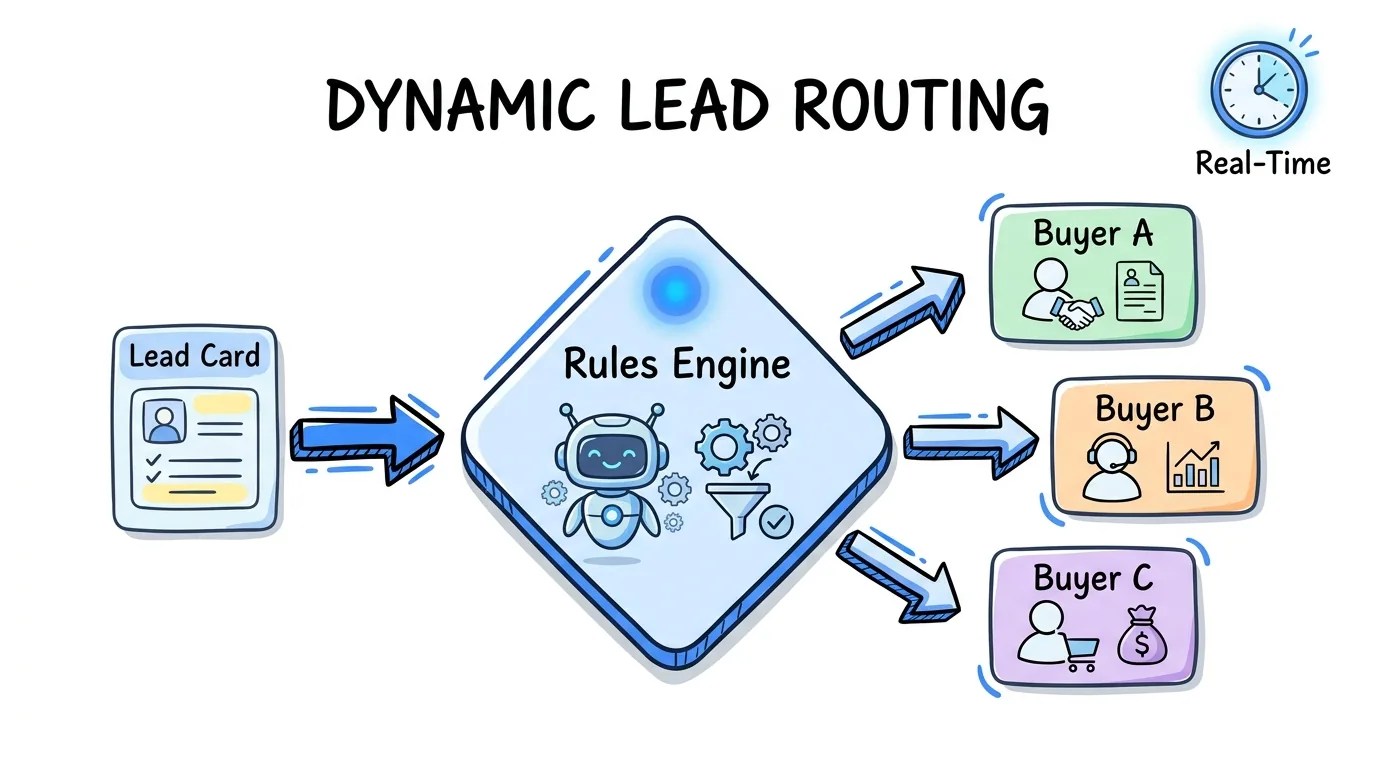
Lead distribution methods determine how each inbound lead is matched to a buyer in your network. The five methods used in modern pay-per-lead operations are round-robin, weighted distribution, waterfall, ping post (shared), and ping post (exclusive). The right choice depends on buyer pricing, capacity, and how price-sensitive your inventory is. Speed-to-lead matters more than method selection alone: an InsideSales.com study analyzing 100,000+ leads found contacting a lead within five minutes makes it 21 times more likely to convert than waiting 30 minutes, which is why every distribution method below executes in under one second. This guide walks through each method, where it wins, and how Lead Distro AI implements it.
Start your free trial of Lead Distro AI. All five methods are available on every plan.
Key Takeaways
- Round-robin distributes leads evenly across buyers paying the same rate
- Weighted distribution splits volume by percentage, used when buyers pay different rates
- Waterfall routes to the highest-priority buyer first, then cascades on rejection or cap-out
- Ping post (shared) runs a real-time auction and posts the same lead to multiple winners
- Ping post (exclusive) runs an auction where only the single highest bidder receives the lead
- Geographic filters, business-hours rules, and buyer caps compose with any of the five methods
Why the Distribution Method Choice Matters
A study by Vendasta of 433 companies found 78 percent of customers buy from the company that responds first, and Harvard Business Review reporting on the InsideSales.com lead-response analysis found firms that contact a prospect within an hour are seven times more likely to have a meaningful conversation than firms that wait even one hour longer. Distribution method affects both: an inefficient method that retries failed buyers serially can add 10 to 30 seconds before a lead reaches a buyer who will actually pick up the phone. Picking the right method for the inventory protects speed-to-lead and per-lead revenue at the same time.
Sources: Vendasta speed-to-lead study, Harvard Business Review on InsideSales.com data.
Method 1: Round-Robin Distribution
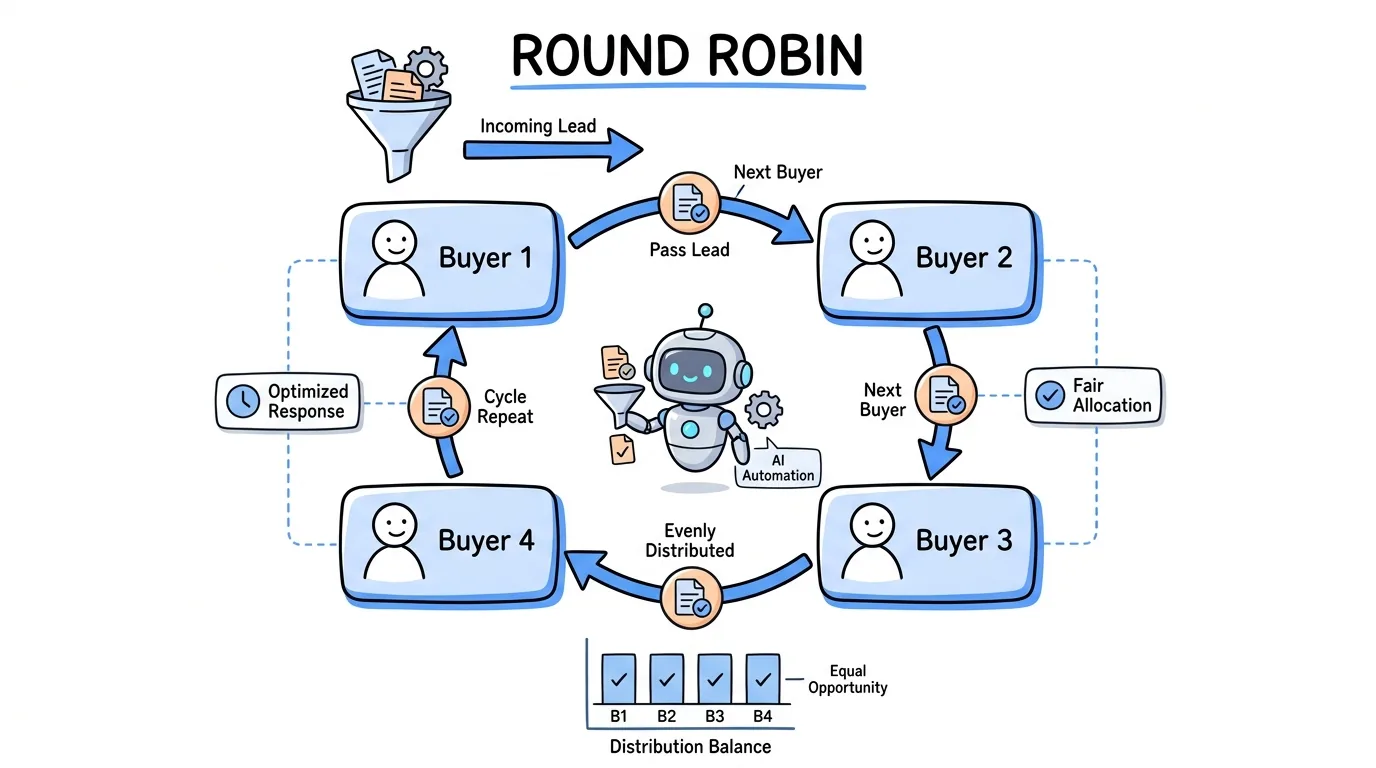
Round-robin routes leads sequentially across buyers: buyer A gets lead 1, buyer B gets lead 2, buyer C gets lead 3, then the cycle repeats. Every buyer in the rotation receives equal volume over time.
How it works:
- Lead arrives and passes filters
- System picks the next buyer in the rotation via an atomic database pointer
- Lead is posted to that buyer
- Pointer advances for the subsequent lead
Best for:
- Buyers who negotiated equal volume splits
- Campaigns where every buyer pays the same per-lead rate
- A/B testing two or three buyers before assigning weights
- Insurance lead networks where carriers want equal opportunity on incoming volume
Not ideal for: Buyers who pay different rates. Round-robin leaves money on the table by sending equal volume to lower-paying buyers.
Lead Distro AI implementation: Set distribution_method = ROUND_ROBIN at the campaign level. The platform uses an atomic Postgres function (pick_next_round_robin_buyer) so two concurrent leads never receive the same buyer, even under spike load.
Method 2: Weighted Distribution
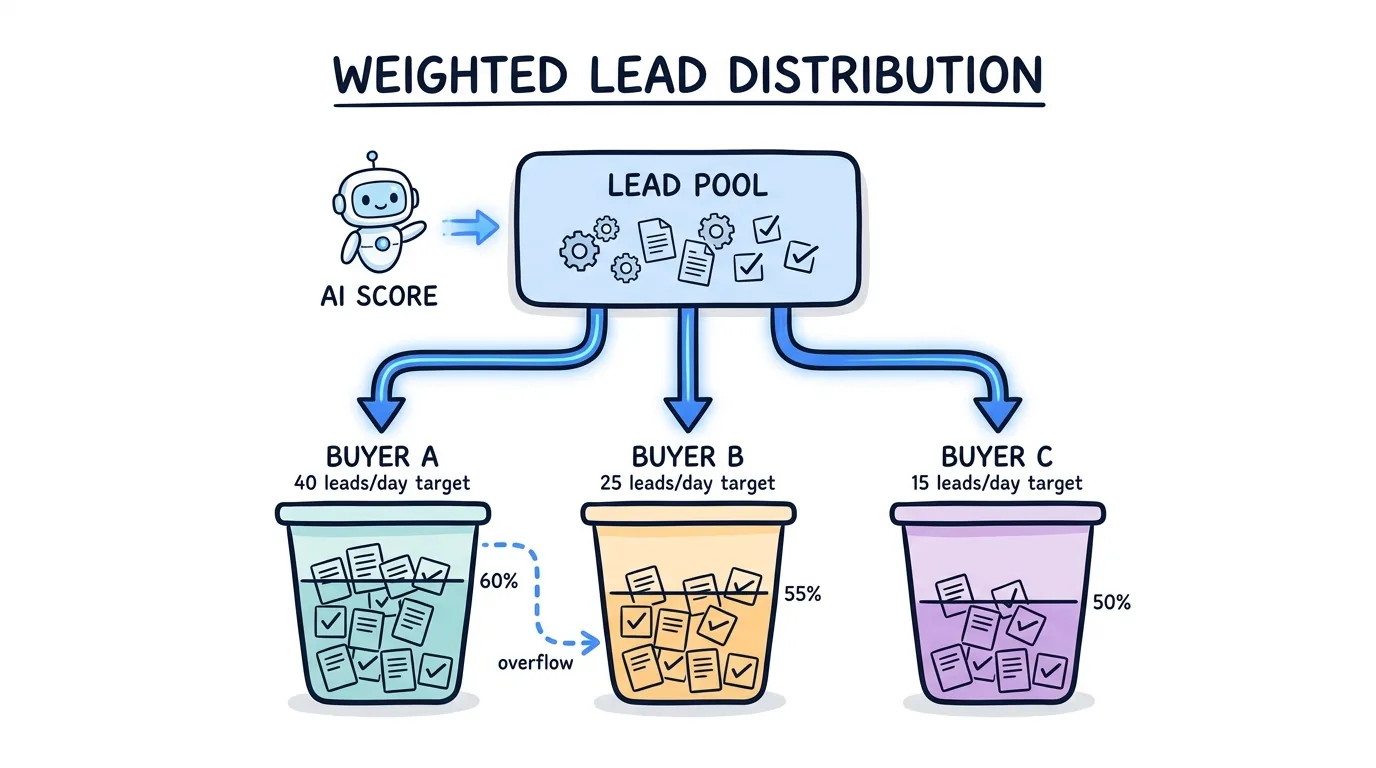
Weighted distribution allocates a percentage of leads to each buyer. A buyer with weight 60 receives 60 of every 100 leads; a buyer at weight 20 receives 20. Lead Distro AI runs one weighted lottery per priority tier, so weights compose with priority groups instead of overriding them.
How it works:
- Lead arrives and passes filters
- System groups eligible buyers by priority tier
- Within each tier, a weight-shuffle picks the winner proportional to assigned weights
- The winner is attempted first; if they reject or cap out, the next tier runs its own lottery
Best for:
- Buyer networks where pricing varies and you want more volume to flow to higher payers
- Volume-committed buyers who need a guaranteed share of your inventory
- Campaigns with two or three pricing tiers across buyers
Not ideal for: Maximizing revenue on individual high-quality leads. A standout lead can still go to a low-weight buyer when the lottery picks them.
Lead Distro AI implementation: Set distribution_method = WEIGHTED. Assign integer weights per buyer in the campaign editor. Weights can be adjusted in real time without redeploying the campaign.
Method 3: Waterfall Distribution
Waterfall builds a priority queue. Every lead is offered to buyer 1 first. If buyer 1 is capped, outside business hours, or rejects the lead via post conditions, it cascades to buyer 2, then buyer 3, and so on. The first buyer to accept gets the lead and the waterfall stops.
How it works:
- Lead arrives and passes filters
- System orders eligible buyers by priority ascending
- Buyer 1: check cap, business hours, and acceptance criteria
- If accepted: deliver. If rejected: log the reason and move to buyer 2
- Continues until a buyer accepts or every tier is exhausted
Best for:
- Maximizing revenue per lead when buyers pay different rates
- Ensuring high fill rate with tiered fallback buyers
- Verticals where premium buyers have hard daily caps: legal, solar, mortgage
- Replacing manual ESC (escalation) processes inside CRMs
Not ideal for: Buyers with similar pricing. A static priority ordering can strain relationships with lower-priority buyers who feel starved.
Lead Distro AI implementation: Set distribution_method = WATERFALL. Buyer priority is set in the campaign editor (1 = top, ascending). Daily, weekly, and monthly caps stop a buyer automatically once they hit volume. A distribution deadline guard halts the waterfall before Vercel's serverless timeout to avoid stranded leads.
Method 4: Ping Post Distribution (Shared Mode)
Ping post (shared mode) runs a real-time auction. The system pings eligible buyers with partial lead data, collects bids, and posts the full lead to multiple buyers who accept, in priority order. The same lead can be sold to two or three buyers when shared-mode posting is enabled, which is standard practice in insurance and home services where buyers compete for the same prospect post-purchase.
How it works:
- Lead arrives and passes filters
- Partial lead data (state, vertical, intent signals) is pinged to all eligible ping-post buyers
- Buyers respond with a bid amount or a rejection inside a configured timeout window
- Highest bidder above the floor wins the auction
- Full lead is posted to the winner; in shared mode, additional bidders may also receive the lead per their tier
Best for:
- Letting the market set the price on each lead
- High-competition verticals: insurance, mortgage, solar
- Lead sellers who want price discovery instead of negotiated fixed rates
- Multi-buyer fulfillment models
Not ideal for: Buyers who require contractual exclusivity. Shared posting means the prospect is being worked by multiple companies.
Lead Distro AI implementation: Enable ping post on the campaign and set ping_post_settings.pingPostType = "shared". Configure floor price, ping timeout, and field mapping for the ping payload. Bid history and post outcomes are logged per lead for compliance and reconciliation.
Method 5: Ping Post Distribution (Exclusive Mode)
Ping post (exclusive mode) runs the same real-time auction but posts the full lead to only one buyer: the single highest bidder above the floor. This is the model expected in legal and personal injury, where buyers require exclusive ownership of a prospect and will not accept shared leads.
How it works:
- Lead arrives and passes filters
- Partial lead data is pinged to all eligible buyers
- Buyers respond with bids inside the timeout window
- The highest bidder above the floor is identified
- Only the winner's cap is incremented and only the winner receives the full post
- If delivery to the winner fails, the lead is marked ERROR; the platform does not fall back to other bidders in exclusive mode
Best for:
- Personal injury, criminal defense, and other verticals where buyers contract for exclusive leads
- High-ticket inventory where one bidder's purchase price covers the lead's full margin
- Campaigns where shared-lead complaints would damage buyer relationships
Not ideal for: Maximizing per-lead resale revenue across multiple buyers. Exclusive mode trades resale volume for higher per-lead pricing and cleaner buyer relationships.
Lead Distro AI implementation: Enable ping post and set ping_post_settings.pingPostType = "exclusive". The cap-increment is atomic on the winner only, eliminating the double-post race condition that plagues homegrown auction systems.
Routing Controls That Compose With Every Method
Distribution method is the top-level routing decision, but every method composes with three filter layers Lead Distro AI applies before the method runs:
- Geographic filters: Per-buyer allowed-states lists. A lead is filtered out for any buyer whose state allowlist does not include the lead's state, before round-robin, weighted, waterfall, or ping post even consider that buyer.
- Business-hours and schedule filters: Per-buyer schedule windows (timezone-aware). A buyer in PST who only accepts leads from 9am to 6pm is silently skipped at 8pm EST.
- Daily, weekly, and monthly buyer caps: Atomic increment on accept. Caps are checked at delivery time so concurrent leads cannot push a buyer over cap.
These three filter layers make industry concepts like "geo-based routing" and "time-of-day routing" implementation details inside Lead Distro AI rather than separate methods. Pick the method, then layer the filters.
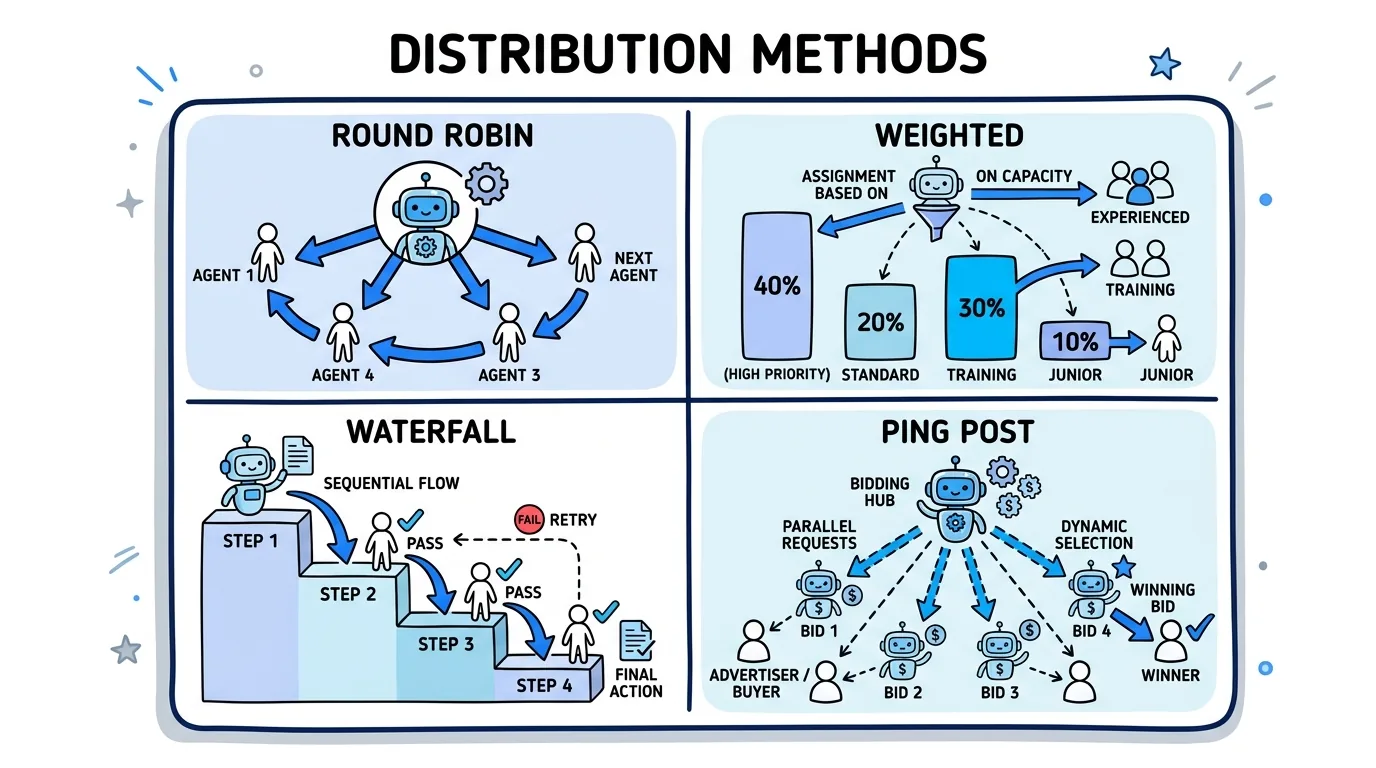
Methods Compared
| Method | Buyer experience | Seller revenue ceiling | Best fit |
|---|---|---|---|
| Round-robin | Equal opportunity, predictable | Same as average buyer rate | Equal-price buyers, A/B testing |
| Weighted | Volume guaranteed by percentage | Higher than round-robin when rates differ | Multi-tier rate cards, volume commitments |
| Waterfall | Top buyer gets first look | High when buyer 1 has cap headroom | Premium buyer with daily cap, tiered fallback |
| Ping post (shared) | Buyers bid, multiple winners | Highest when 4+ buyers compete | Insurance, home services, mortgage |
| Ping post (exclusive) | One winner per auction | High per-lead, lower resale volume | Personal injury, criminal defense, exclusive-only contracts |
Distribution Method Selection by Vertical
| Vertical | Recommended primary method | Why |
|---|---|---|
| Personal injury, criminal defense | Ping post (exclusive) | Buyers require exclusive leads contractually |
| Insurance | Ping post (shared) or weighted | Multiple carriers, variable pricing by state and line |
| Mortgage | Waterfall or ping post (shared) | Speed-critical, tiered buyer network, price-competitive |
| Solar | Waterfall or weighted | Territory caps, tiered buyer quality |
| Home services | Round-robin or ping post (shared) | Competitive within territory, multi-buyer purchase common |
Combining Methods Across Campaigns
Most agencies do not pick one method and stop. A typical Lead Distro AI account runs different methods on different campaigns:
- Ping post (exclusive) on PI leads for one law firm network
- Waterfall on auto insurance with a top carrier capped at 50 leads per day
- Weighted on health insurance across three brokers with different per-lead rates
- Round-robin on home services across two equal-volume contractors
Each campaign carries its own distribution method, ping-post settings, buyer roster, and filter rules. Switching a campaign's method is a single dropdown change in the campaign editor and takes effect on the next inbound lead. See how routing methods configure inside the dashboard in the product tour. For a side-by-side comparison of platforms that support each model, see the best lead routing software guide.
Frequently Asked Questions
What is the difference between round-robin and weighted distribution?
Round-robin sends an equal share of volume to every buyer in the rotation, regardless of pricing. Weighted distribution assigns a percentage share to each buyer, so higher-paying buyers can receive 60 percent of leads while lower-paying buyers receive 20 percent. Round-robin maximizes fairness; weighted maximizes revenue when buyers pay different rates.
When should I use ping post versus waterfall?
Use waterfall when buyer pricing is stable and you have a clear premium-to-fallback tier structure. Use ping post when buyer pricing is dynamic, competition is high, and you want market price discovery on each lead. Ping post typically increases revenue per lead 20 to 40 percent over fixed waterfall pricing in competitive verticals, at the cost of requiring buyer bid endpoints.
What is the difference between ping post shared mode and exclusive mode?
In shared mode, the full lead can be posted to multiple winning bidders in priority order, which is standard in insurance and home services. In exclusive mode, only the single highest bidder receives the lead, which is required in personal injury and criminal defense where buyers will not accept shared leads. Lead Distro AI configures this via the pingPostType setting on the campaign.
Does Lead Distro AI support skill-based routing?
No. Skill-based routing is a B2B sales-rep concept (route to the rep with the right product knowledge). Lead Distro AI is built for pay-per-lead and pay-per-call operations where buyers are external companies. State filters, vertical filters, and per-buyer post conditions cover the equivalent matching logic for this use case.
Can I run multiple distribution methods in the same account?
Yes. Distribution method is set per campaign. A single Lead Distro AI account can run ping post (exclusive) on PI campaigns, waterfall on mortgage campaigns, and round-robin on home services campaigns simultaneously. Each campaign maintains its own buyer roster, caps, and ping-post settings.
How fast does each distribution method execute?
All five methods complete the routing decision in under one second under normal load, and full delivery (lead posted to the winning buyer) typically completes inside two seconds for direct-post methods (round-robin, weighted, waterfall). Ping post adds the configured ping timeout window (commonly 2 to 5 seconds) because the system has to collect buyer bids before posting.
The Bottom Line
The five lead distribution methods are tools, not rules. Round-robin and weighted are best when buyer pricing is stable; waterfall is best when you have a premium top buyer with a hard cap; ping post (shared) is best for competitive multi-buyer verticals; ping post (exclusive) is best when contracts require single-winner delivery. Most mature lead operations run two or three methods across different campaigns. Start with the method that matches your top revenue inventory, then expand as the buyer network grows. Compare the platforms that implement these methods in our best lead distribution software guide, or dive deeper into the auction mechanic with our ping post lead distribution explainer.
Ready to configure any of the five methods inside Lead Distro AI? Start your free trial or take the product tour to see round-robin, weighted, waterfall, and both ping post modes in action.
About the Author
Founder & CEO of Lead Distro AI & Great Marketing AI
UC Berkeley graduate and former software engineer at Microsoft. Rafael built Lead Distro AI after managing over $10M in ad spend for performance marketing agencies (pay-per-lead and pay-per-call), including running campaigns for Neil Patel. He combines deep software engineering expertise with hands-on performance marketing experience to build tools that help these agencies scale profitably.
About Lead Distro AI
Lead Distro AI: AI-Powered Lead Distribution & Call Tracking That Maximizes ROI
The modern platform for pay-per-lead and pay-per-call agencies. Route, score, and deliver leads with AI-powered automation and real-time P&L tracking. Built for performance marketing agencies and lead buyers across legal, insurance, mortgage, solar, and home services verticals.
4 Distribution Methods
Waterfall, Round Robin, Weighted, Ping-Post
Ping-Post Auctions
Real-time bidding with sub-second routing
Real-Time P&L Reporting
Track revenue, costs, and profit per campaign
Call Tracking
Assign tracking numbers, record calls, and attribute conversions
Lead Scoring
Score every lead before routing to maximize conversion
Partner Portal
Self-serve dashboard for buyers to track leads