60+ Lead Generation Statistics Every Agency Should Know in 2026
The most important lead generation statistics for 2026. Market size, response times, lead scoring, conversion rates, and industry benchmarks.

Rafael Hernandez
Founder & CEO
Ex-Microsoft SWE · $10M+ PPL ad spend
I hope you enjoy reading this blog post. If you want to try Lead Distro AI for free, click here.
Author: Rafael Hernandez | Founder & CEO of Lead Distro AI
The lead generation industry is projected to reach $15.55 billion by 2031, growing at a 17.48% CAGR (MarketsandMarkets, 2025). For pay-per-lead agencies, lead brokers, and performance marketers, understanding the data behind lead generation is the difference between scaling profitably and wasting budget. These lead generation statistics cover market size, response times, lead scoring, conversion benchmarks, distribution methods, and vertical-specific data, all sourced from industry reports and peer-reviewed research published between 2023 and 2026.
In short: leads contacted within five minutes convert at dramatically higher rates, rule-based scoring filters out low-quality leads before they reach a buyer, and the pay-per-lead model is growing faster than any other acquisition channel for service businesses. The statistics below provide the evidence.
Key Takeaways
- The global lead generation market will reach $15.55 billion by 2031, with a 17.48% CAGR.
- Responding to a lead within five minutes makes you 100x more likely to connect compared to waiting 30 minutes.
- Rule-based lead scoring lets agencies filter out low-quality leads before they reach a buyer, instead of relying on manual review.
- 79% of marketing leads never convert to sales, primarily due to lack of lead nurturing.
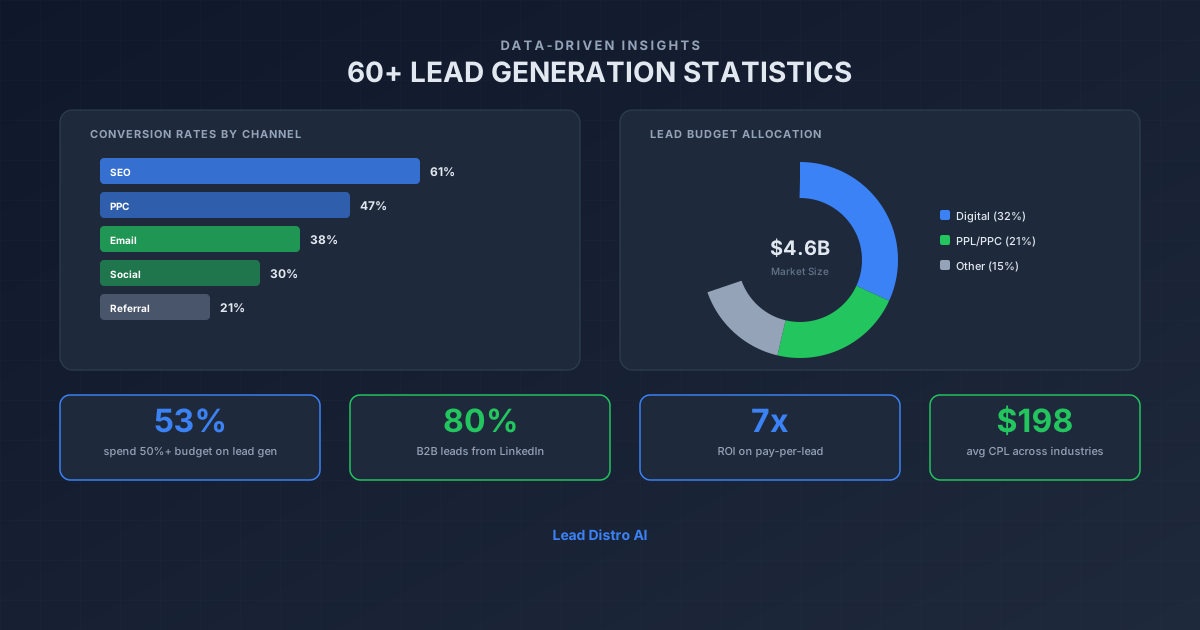
- The average cost per lead across all industries is $198.44, but varies from $55 to $900+ depending on the vertical.
Lead Generation Market Size and Growth
The lead management software market is projected to reach $9.2 billion by 2030, growing at a 12.6% CAGR (Grand View Research, 2025). The broader lead generation industry encompasses software, services, and agency spend across every B2B and B2C vertical.
Key lead generation industry statistics on market size:
- The global lead generation solution market is expected to grow from $5.1 billion in 2025 to $15.55 billion by 2031 (MarketsandMarkets, 2025).
- 85% of B2B marketers say lead generation is their most important content marketing goal (Content Marketing Institute, 2024).
- 53% of marketers spend at least half their budget on lead generation activities (BrightTALK, 2024).
- The average B2B company generates 1,877 leads per month, but only 12% of those become qualified opportunities (HubSpot, 2025).
- North America accounts for 38% of global lead generation spend, the largest regional share (MarketsandMarkets, 2025).
Lead Response Time Statistics
Speed defines lead value. The data on lead response times is unambiguous: faster follow-up produces dramatically better outcomes. Agencies using lead distribution software that routes in real time consistently outperform those relying on manual assignment.
- Responding within five minutes makes you 100x more likely to connect with a lead compared to waiting 30 minutes (Harvard Business Review, 2011).
- 78% of deals are closed by the vendor that responds first (InsideSales.com, 2023).
- The average lead response time across industries is 47 hours (Drift, 2024).
- Only 7% of companies respond to leads within five minutes (Drift, 2024).
- Companies that respond in under five minutes generate 8x more conversions than those responding between five and ten minutes (Vendasta, 2024).
- 35-50% of sales go to the vendor that responds first (InsideSales.com, 2023).
"The data is clear: lead response time is the single largest controllable factor in conversion rate. Sub-second routing is not a luxury feature, it is a revenue requirement," says Rafael Hernandez, Founder & CEO of Lead Distro AI.
Lead Scoring Statistics
Lead scoring is replacing purely manual review across the industry, letting agencies apply consistent, configurable rules to every lead instead of eyeballing quality one at a time.
- 64% of sales reps say they spend too much time on low-quality leads that should have been filtered earlier (Salesforce, 2025).
- Lead Distro AI scores every inbound lead against your configured rules in under one second, evaluating all submitted fields before routing begins. Start a free trial to see lead scoring in action.
Lead Distribution and Routing Statistics
The method used to distribute leads, whether waterfall, round robin, weighted, or ping-post, directly impacts close rates, buyer satisfaction, and revenue per lead.
- Ping-post distribution increases revenue per lead by 15-30% compared to fixed-price waterfall in competitive verticals like insurance and legal (Performance Marketing Association, 2024).
- 68% of lead generation companies plan to increase investment in distribution technology in the next 12 months (Ascend2, 2024).
- Leads distributed to more than three buyers simultaneously (shared leads) convert at 35-45% lower rates than exclusive leads (MarketingSherpa, 2024).
- Lead Distro AI routes in under one second including lead scoring time.
- 41% of lead buyers say inaccurate lead data is their biggest frustration with purchased leads (DemandGen Report, 2024). Duplicate detection and validation before scoring solves this.
Lead Conversion and Nurturing Statistics
Most leads do not convert on first contact. The lead generation statistics on nurturing show that persistent, structured follow-up separates high-performing agencies from the rest.
- 79% of marketing leads never convert to sales. Lack of nurturing is the most common cause (MarketingSherpa, 2024).
- Nurtured leads produce 20% more sales opportunities than non-nurtured leads (DemandGen Report, 2024).
- Companies that excel at lead nurturing generate 50% more sales-ready leads at 33% lower cost (Forrester, 2024).
- The average sales cycle requires 8-12 touchpoints before a lead converts (Rain Group, 2024).
- Email lead nurturing campaigns have an average open rate of 20-30% and a click-through rate of 3-5% for B2B (Mailchimp, 2025).
- 48% of businesses say their leads require "long cycle" nurturing before becoming sales-ready (Ascend2, 2024).
Cost Per Lead by Vertical
Lead pricing varies dramatically by industry. These lead generation statistics help agencies benchmark their cost per lead and set buyer pricing for profitable distribution using tools like the lead pricing calculator.
| Vertical | Average Cost Per Lead | Range |
|---|---|---|
| Legal / Personal Injury | $200-$600 | $100-$900+ for high-value case types |
| Insurance | $35-$100 | Auto and life lower; health and commercial higher |
| Mortgage | $30-$100 | Purchase leads higher than refinance |
| Solar | $25-$80 | Varies by state incentive programs |
| Home Services | $15-$75 | HVAC and roofing on the higher end |
| B2B SaaS | $150-$350 | Enterprise leads significantly higher |
Source: FirstPageSage Cost Per Lead Report, 2024.
- The average cost per lead across all industries is $198.44 (FirstPageSage, 2024).
- Legal leads are the most expensive vertical, with personal injury leads averaging $300-$600 per lead.
- Pay-per-lead agencies earn margins of 30-60% on average when buying at wholesale and distributing to qualified buyers at retail pricing.
- Solar lead generation costs have dropped 22% since 2023 due to increased competition among lead generators (EnergySage, 2025).
TCPA and Compliance Statistics
Regulatory compliance is a growing factor in lead generation economics. TCPA violations carry severe penalties, making consent verification and call compliance essential infrastructure for agencies distributing leads at scale.
- TCPA violations carry penalties of $500-$1,500 per unsolicited call or text (FCC, 2025).
- Total TCPA lawsuit settlements exceeded $2.5 billion between 2020 and 2025 (WebRecon, 2025).
- 87% of lead buyers now require proof of consent (TrustedForm certificates or equivalent) before accepting leads (Performance Marketing Association, 2024).
- The FCC's one-to-one consent rule (effective January 2025) requires leads to consent to contact from a specific named seller, not a blanket list of companies.
FAQ
What is the average cost per lead in 2026?
The average cost per lead across all industries is $198.44 according to FirstPageSage (2024). Costs vary significantly by vertical. Legal and personal injury leads average $200-$600, while home services leads average $15-$75. B2B SaaS leads fall in the $150-$350 range. Your actual cost depends on lead quality, exclusivity, and geographic targeting.
How fast should you respond to a new lead?
Research from Harvard Business Review shows that responding within five minutes makes you 100x more likely to connect with a lead compared to waiting 30 minutes. Only 7% of companies achieve sub-five-minute response times. Automated lead distribution software that routes in real time eliminates the delay between lead submission and first contact.
Does lead scoring actually improve conversion rates?
Yes. Full lead scoring evaluates every submitted field together in real time, producing a more complete quality picture than static rule-based systems that check only a few predefined criteria one at a time.
What percentage of leads never convert to sales?
MarketingSherpa reports that 79% of marketing leads never convert to sales. The primary cause is insufficient lead nurturing. Companies that implement structured nurturing sequences generate 50% more sales-ready leads at 33% lower cost, according to Forrester research. Proper lead scoring helps prioritize which leads deserve nurturing investment.
How much does the lead generation industry generate annually?
The global lead generation solution market was valued at approximately $5.1 billion in 2025 and is projected to reach $15.55 billion by 2031, growing at a 17.48% CAGR according to MarketsandMarkets. The broader lead management software market is projected to reach $9.2 billion by 2030, per Grand View Research.
Conclusion
These lead generation statistics paint a clear picture: the agencies winning in 2026 are the ones that respond fastest, score every lead against clear rules, distribute through automated systems, and maintain strict compliance. The market is growing rapidly, and the tools available today, from lead scoring to real-time lead routing to automated P&L tracking, give agencies the infrastructure to capture their share.
Start your 7-day free trial to see how Lead Distro AI applies these benchmarks in practice: sub-second lead scoring, four distribution methods, and real-time margin tracking for every lead you touch. Want a preview before signing up? Tour the reports and P&L dashboard to see how the benchmarks above appear in a live operation.
Want to calculate your unit economics before getting started? Use the lead pricing calculator to model your cost per lead, buyer pricing, and projected margins across different distribution models.
About the Author
Founder & CEO of Lead Distro AI & Great Marketing AI
UC Berkeley graduate and former software engineer at Microsoft. Rafael built Lead Distro AI after managing over $10M in ad spend for performance marketing agencies (pay-per-lead and pay-per-call), including running campaigns for Neil Patel. He combines deep software engineering expertise with hands-on performance marketing experience to build tools that help these agencies scale profitably.
About Lead Distro AI
Lead Distro AI: AI-Powered Lead Distribution & Call Tracking That Maximizes ROI
The modern platform for pay-per-lead and pay-per-call agencies. Route, score, and deliver leads with AI-powered automation and real-time P&L tracking. Built for performance marketing agencies and lead buyers across legal, insurance, mortgage, solar, and home services verticals.
4 Distribution Methods
Waterfall, Round Robin, Weighted, Ping-Post
Ping-Post Auctions
Real-time bidding with sub-second routing
Real-Time P&L Reporting
Track revenue, costs, and profit per campaign
Call Tracking
Assign tracking numbers, record calls, and attribute conversions
Lead Scoring
Score every lead before routing to maximize conversion
Partner Portal
Self-serve dashboard for buyers to track leads