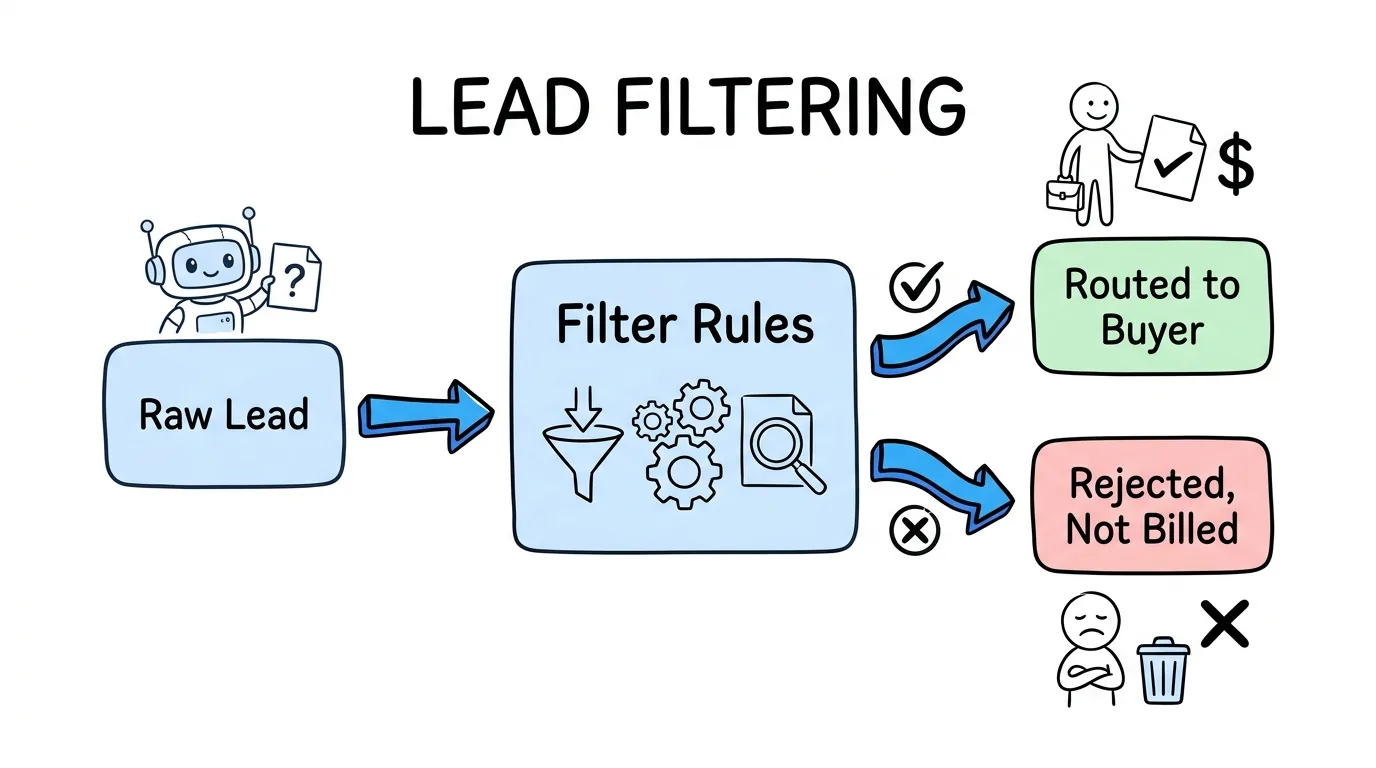
Lead Fraud Prevention: The Complete 2026 Guide for Pay-Per-Lead Agencies
Lead fraud costs agencies thousands in wasted spend. This guide covers the 7 most common fraud types, how to detect them, and how Lead Distro AI's built-in checks catch them at intake.

Rafael Hernandez
Founder & CEO, Great Marketing AI
Ex-Microsoft SWE · $10M+ PPL ad spend
I hope you enjoy reading this blog post. If you want to try Lead Distro AI for free, click here.
Author: Rafael Hernandez | Founder & CEO of Lead Distro AI
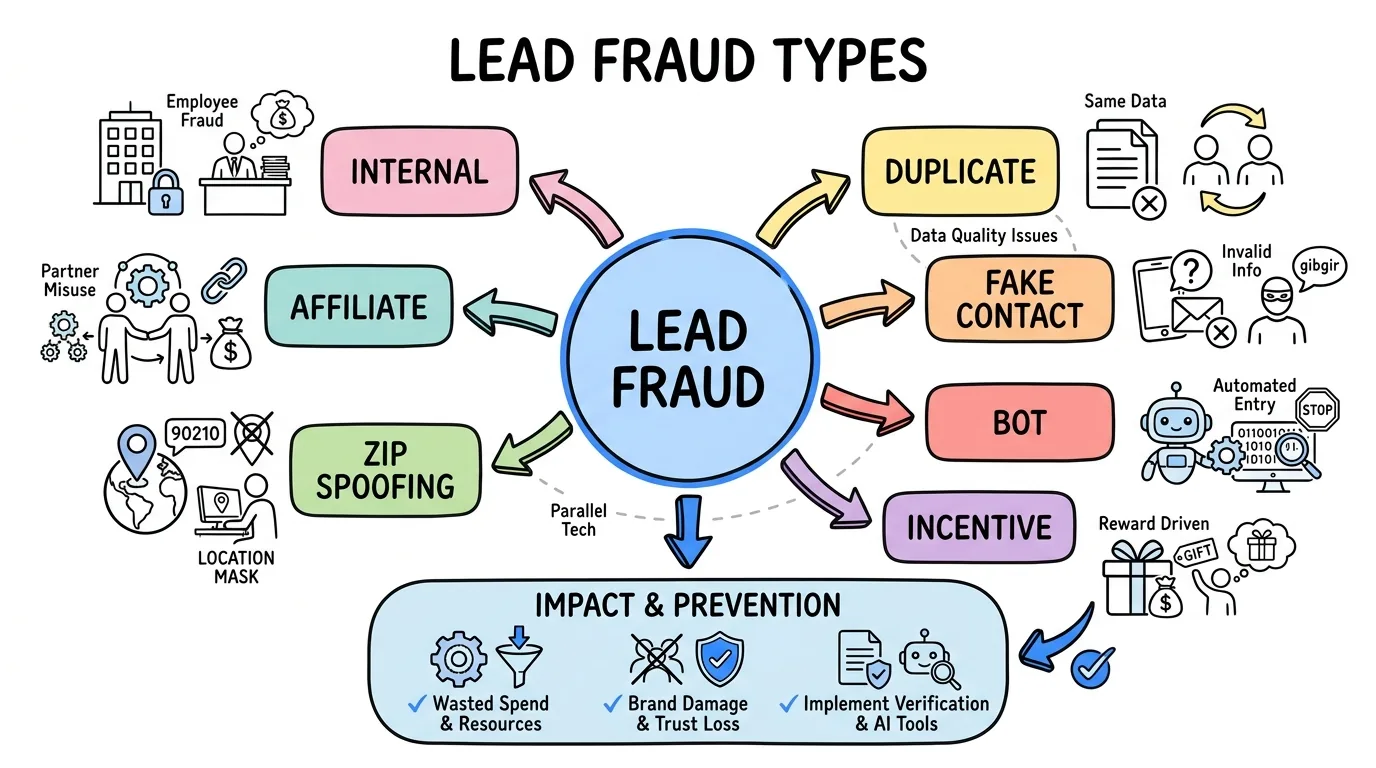
Lead fraud is the deliberate submission of invalid, fabricated, or manipulated contact information to generate a payout without delivering genuine buyer intent. For pay-per-lead agencies, even a 10 percent fraud rate can wipe out margin on an entire campaign and erode trust with the buyers who fund the operation. Unlike click fraud in paid search, lead fraud is harder to catch because a fraudulent submission looks identical to a legitimate one at intake. The difference surfaces later: when a sales team dials and the number is disconnected, when the ZIP code routes the lead to the wrong state, or when the same contact appears in the system for the third time this month.
The financial damage is only part of the risk. Buyers who receive fraudulent leads reduce their bids, demand refunds, or cancel contracts entirely. Publishers who game forms collect payment for nothing. And under the Telephone Consumer Protection Act (TCPA), a single non-consensual call triggered by a fraudulent submission can carry statutory damages of up to $1,500 per contact under the TCPA's private right of action.
Manual intake lets a large share of that fraud pass through undetected, and every fake lead that gets through inflates the cost per acquired customer for every buyer in the network.
This guide covers the seven most common lead fraud types, the detection methods that actually scale, and the specific protections that Lead Distro AI ships by default so agencies are not starting from zero.
Key Takeaways
- Lead fraud is deliberate manipulation, not poor targeting: a bot, publisher, or consumer has intentionally submitted invalid data to extract a payout. This is categorically different from a low-quality lead, which is a real person who is simply a poor fit.
- Duplicate leads are the most common fraud type: the same contact submitted multiple times, by the same or different publishers, each generating a separate charge to the buyer.
- Server-side verification is the only reliable defense: fraud checks that run client-side can be bypassed by browser extensions or developer tools. Phone OTP, service-area enforcement, and duplicate detection must all run on the server.
- Consent proof is part of fraud defense: the FCC's one-to-one consent rule was vacated in January 2025 before it took effect, but a TrustedForm or Jornaya record on every lead is still what separates a real opt-in from a fabricated one.
- Automated detection outperforms manual review at every scale threshold: speed, accuracy, coverage, and cost-per-check all favor automation once daily volume exceeds a few hundred leads.
- Lead Distro AI ships duplicate detection, phone verification on funnel forms (OTP via Twilio Verify), server-side ZIP resolution, and consent certificate checks: each one runs on the server, not in the browser.
- A written lead fraud prevention policy is a legal asset: documenting rejection criteria, refund windows, and escalation paths before disputes arise is the foundation of a defensible operation.
The 7 Most Common Types of Lead Fraud
These seven categories account for the vast majority of fraudulent activity across pay-per-lead programs in insurance, legal, home services, and financial verticals.
1. Duplicate leads. The same contact submitted more than once, either by the same publisher across multiple forms or by different publishers who draw from a shared lead pool. Buyers pay twice for one prospect. Phone and email hash-matching at intake eliminates most cases before distribution begins. For a technical walkthrough of how matching windows and lookback periods work, see our guide on duplicate lead detection.
2. Fake contact information. A submission carrying a disconnected phone number, a non-existent email domain, or an obviously fabricated name. Publishers who need to hit volume minimums generate these when they exhaust real prospects. Phone OTP verification eliminates phone-number fabrication; real-time email validation APIs catch the email side by checking whether the domain accepts mail.
3. Bot submissions. Automated scripts that fill out and submit forms at scale, most often in high-payout verticals such as personal injury and insurance. Basic reCAPTCHA challenges stop primitive bots, but modern bot traffic mimics human behavior closely enough that server-side phone OTP verification is the strongest practical defense for high-value leads.
4. Incentive or gaming fraud. Real people who complete a qualification form not because they want the product but because they want access to a survey reward, gift card, or other incentive. These leads have valid contact information and answer questions honestly to proceed, but buyer intent is zero. Behavioral signals (time-to-complete, field edit patterns) can flag suspicious patterns for manual review, though no automated check catches all cases.
5. Service-area fraud (ZIP spoofing). A prospect submits a ZIP code that places them inside a premium coverage zone when they are actually located outside it. Buyers who pay a geographic premium for specific counties or metro areas are the primary victims. Server-side ZIP resolution that fills in city, state, and county from the ZIP at intake closes part of this gap: a submitter cannot pair a premium state or county with a ZIP outside it. It cannot prove the consumer lives at that ZIP, so pair it with phone verification and buyer-side disposition feedback.
6. Affiliate and partner fraud. Publishers in the network who use incentivized traffic sources, including paid survey panels, cashback programs, and pop-under placements, to generate form completions. Most publisher agreements treat undisclosed incentivized traffic as a material violation, because the consumer's motivation is the incentive rather than the product.
7. Internal fraud. A less-discussed but real category: sales team members who cherry-pick leads from the distribution queue, leave the remainder unworked, and later claim the unchosen leads were fraudulent to avoid accountability. A timestamped audit trail of every routing decision, delivery confirmation, and disposition is the only reliable defense. Platforms that log each event by timestamp make internal fraud visible instantly.
How to Detect Lead Fraud Without Manual Review
Manual review does not scale. If one reviewer can inspect 50 leads a day in depth and you take in 500, 90 percent of volume goes unchecked. Layered automated detection is the only practical approach for agencies past the early-stage phase.
| Detection Method | Speed | What it catches | Scalability | Typical Cost |
|---|---|---|---|---|
| Manual review | Minutes per lead | Anything a trained reviewer spots, on reviewed leads only | Poor | Reviewer labor |
| Email validation API | Milliseconds | Undeliverable addresses and dead domains | Excellent | Fraction of a cent per check |
| Phone OTP verification | Seconds (user-facing) | Numbers the submitter does not control | Excellent | Per-verification fee |
| Duplicate detection (hash match) | Milliseconds | Exact repeat phone numbers and emails | Excellent | Included in most platforms |
| Server-side ZIP resolution | Milliseconds | City, state, or county that does not match the ZIP | Excellent | Included in most platforms |
| Bot detection (behavioral) | Milliseconds | Scripted submissions, with some false positives | Excellent | Varies by vendor |
The most cost-effective stacks layer these methods in order of marginal cost: deduplication first (no marginal cost after platform setup), service-area enforcement second (also included), behavioral bot filtering third, and phone OTP last for verticals where the per-check cost is justified by the lead payout.
Each verification layer catches a different kind of fraud, so the stack as a whole catches far more than any single check achieves alone.
Built-In Fraud Prevention in Lead Distro AI
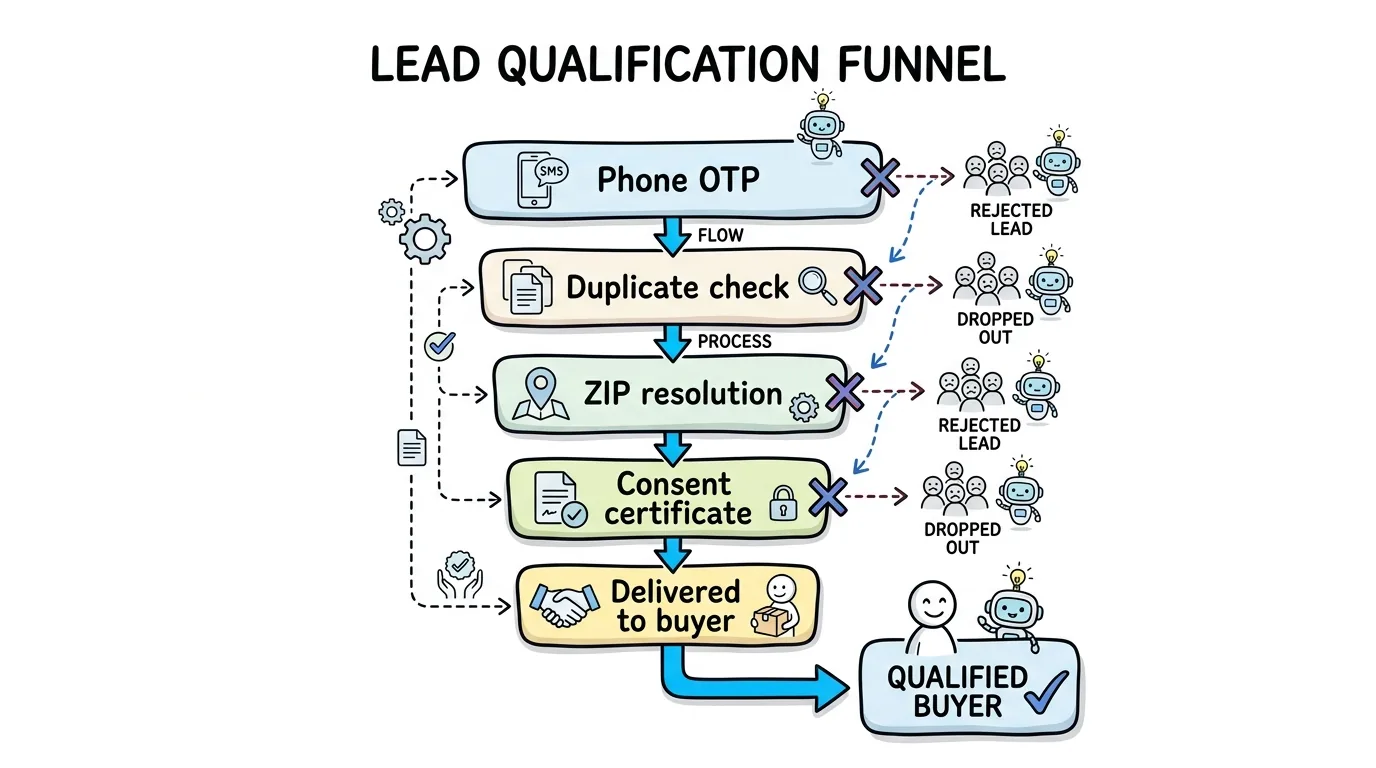
Lead Distro AI ships the following protections as part of the platform. Duplicate detection, ZIP resolution, and phone verification need no separate vendor account; consent certificate checks use your own TrustedForm or Jornaya credentials.
Duplicate lead detection. Every incoming submission is matched against the existing lead pool by phone number and email address before it enters the distribution queue. Duplicates are flagged and withheld automatically. Buyers never receive a lead they have already been charged for in the lookback window.
Phone OTP verification via Twilio Verify. When enabled on a form built with the Lead Distro AI funnel builder, the platform sends a one-time passcode to the phone number the prospect enters on the form. The prospect must submit the correct code to complete the intake. This check runs server-side with a signed token, which means there is no client-side path to bypass it. The verification is billed at Twilio's standard per-check rate. For high-value verticals, including personal injury and mortgage, enabling OTP by default is the recommended configuration.
Server-side ZIP resolution. When a campaign enables it, the ZIP code on the lead is resolved server-side to city, state, and county at ingest. The resolved values fill those fields, so a city or state typed into the form cannot contradict the ZIP, and every coverage rule works from one consistent location.
Consent certificate checks. Lead Distro AI validates TrustedForm certificates and Jornaya LeadiD tokens at ingest using your own vendor credentials, and a campaign can require a valid record before a lead routes. A fabricated opt-in with no real form interaction behind it fails the check.
Bot-free funnel analytics. Funnel visit stats exclude self-identifying automation such as crawlers, uptime monitors, and link-preview bots, so bot traffic does not distort your conversion rates. The filter is intentionally conservative, so it never drops a real visitor. For form fraud, layer phone verification on top.
Consent presets (TCPA, terms and privacy, marketing, age verification). Lead Distro AI ships consent language for common regulatory requirements. These presets are labelled explicitly as starter copy, not legal advice. Every agency should have a TCPA compliance attorney review consent language before deploying to production forms.
Consent Records and Lead Fraud
Consent fraud is the quietest form of lead fraud: a publisher submits a real person's contact details with an opt-in the consumer never gave. The lead looks clean at intake, and the problem surfaces only when the consumer answers a sales call they never asked for, which is exactly the call that turns into a TCPA claim.
The rules on who a single consent can cover have been in flux. In December 2023 the FCC adopted a one-to-one consent rule (Report and Order FCC 23-107) that would have required each seller to be named individually on the form. It never took effect: on January 24, 2025, one business day before its effective date, the Eleventh Circuit vacated it in Insurance Marketing Coalition Ltd. v. FCC. Our guide to one-to-one consent covers what that means for buyers and sellers in 2026. Bundled consent is again permissible under the federal TCPA, but state laws and many buyer contracts still set stricter terms.
Whatever the consent standard, the fraud defense is the same: independent proof that a real consumer saw the disclosure and agreed. A TrustedForm certificate or a Jornaya LeadiD token records the form interaction itself, so a fabricated opt-in has nothing behind it. Lead Distro AI validates both at ingest, and a campaign can require a valid record before a lead routes to any buyer.
The FTC (Federal Trade Commission) independently enforces consumer protection rules under its Section 5 authority that may overlap with TCPA requirements in certain lead generation contexts, particularly where deceptive practices are involved. A TCPA compliance attorney should review your complete consent flow, not just the disclosure language.
Lead Fraud vs. Low-Quality Leads: What Is the Difference?
This distinction has direct consequences for refund policy, publisher relationships, and internal accountability. Conflating the two categories creates the wrong incentives and destroys the data integrity that makes a lead program improvable over time.
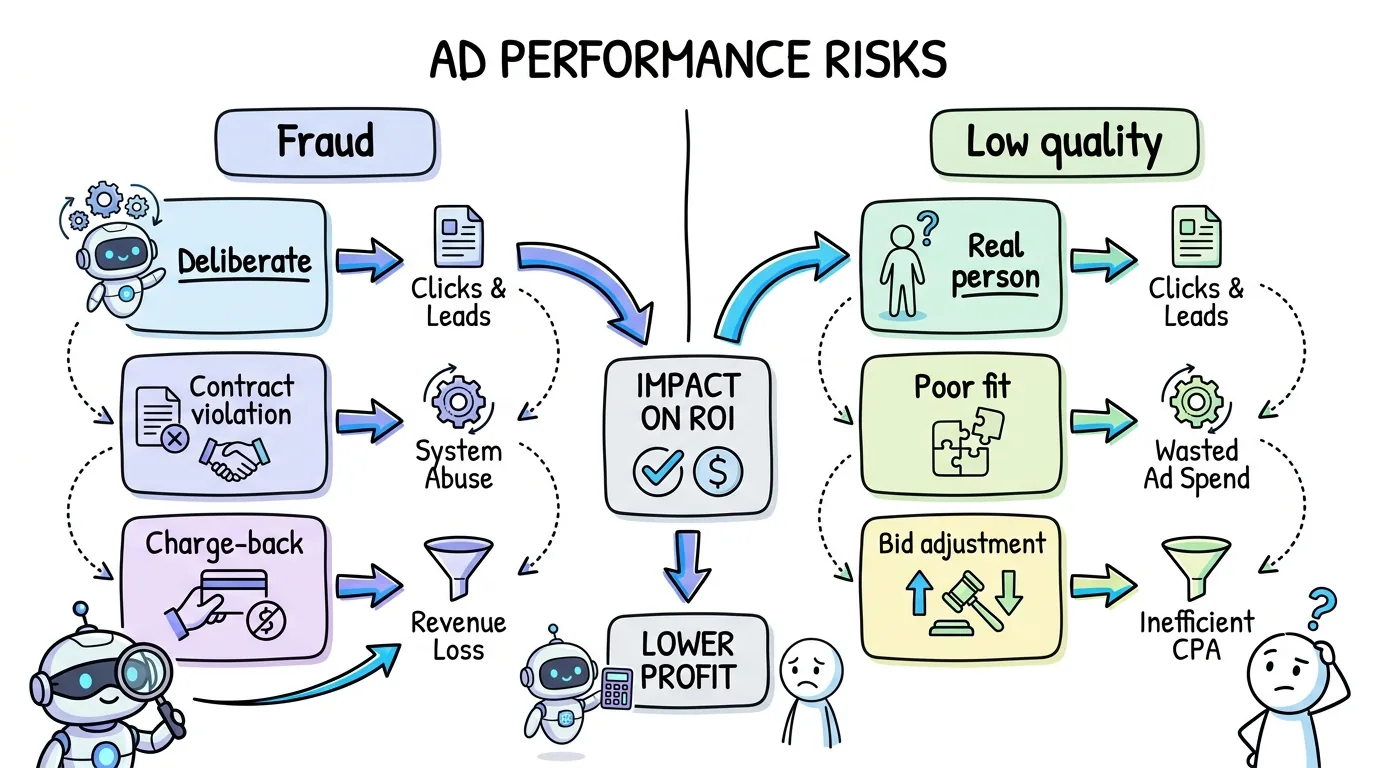
Lead fraud involves deliberate manipulation. A publisher, bot, or consumer has taken a specific action to game the intake system: submitting duplicate contacts, fabricating phone numbers, spoofing geographic data, or automating form completions. Fraud is a contract violation. The appropriate response is a charge-back on affected leads, a formal notice to the publisher, and removal from the network if the pattern continues.
Low-quality leads are real people who opted in and answered qualification questions honestly. They have working contact information and genuine (if mismatched) interest in the product category. They simply are not good candidates for the buyer's specific service: wrong income bracket, wrong timeline, wrong geography. Low quality is a sourcing and targeting problem, addressable through bid adjustments, audience refinement, and publisher performance scoring. It is not fraud, and treating it as fraud creates perverse incentives that damage publisher relationships and inflate charge-back rates beyond what the fraud policy was designed to handle.
Clear written definitions of each category, agreed to by buyers and publishers at the start of the relationship, are the foundation of a dispute-resistant pay-per-lead operation.
How to Build a Lead Fraud Prevention Policy
A fraud prevention policy that exists only in conversation is not enforceable. Document the following components before the first dispute arrives.
Define each fraud category explicitly. Start with the seven types above. Specify exactly what constitutes a duplicate (same phone number within 30 days? 90 days?), what constitutes fake contact information (disconnected at delivery? disconnected within 72 hours of delivery?), and what constitutes a bot submission (OTP failure? velocity above a specific threshold per IP?).
Set rejection criteria and refund windows. Buyers need to know how long they have to dispute a lead and what documentation is required to support a dispute. Publishers need to know what behavior results in removal from the network. Standard windows in the industry are 24 to 72 hours for contact validity disputes and 7 to 14 days for quality disputes. Publish these windows in your publisher and buyer agreements.
Require OTP verification for leads above your payout threshold. For leads priced above $30, the cost of a Twilio OTP check is negligible relative to the payout risk. Establish a dollar threshold above which phone verification is mandatory, and configure Lead Distro AI's OTP toggle accordingly.
Score your publisher network quarterly. Track the following metrics per publisher: percentage of leads with working phone numbers at delivery, percentage of leads that result in a contact attempt, and percentage that result in a sales conversation. Publishers who fall below your minimums enter a performance improvement period before the next quarterly review.
Log every lead event with a timestamp. Distribution time, delivery confirmation, contact attempt, disposition, dispute, and resolution. This log is your evidence in every dispute. Lead Distro AI logs each routing decision by timestamp, which means reconstructing the full history of any lead takes seconds rather than hours.
For agencies evaluating which platform to run this stack on, see our overview of lead distribution software. If your operation uses ping-post bidding, fraud detection at the ping layer is covered in our best ping-post platforms guide. For the complete TCPA consent compliance picture alongside fraud prevention, our TCPA compliance guide for lead generation covers the consent record requirements that pair with a fraud prevention policy.
Frequently Asked Questions
What is lead fraud and how is it different from a low-quality lead?
Lead fraud is deliberate manipulation of a form submission to extract a payout without delivering genuine buyer intent. Examples include duplicate contacts, bot submissions, fabricated phone numbers, and spoofed ZIP codes. A low-quality lead is a real person who opted in but is a poor match for the buyer's service. The distinction matters operationally: fraud warrants a charge-back and publisher review, while low quality warrants a bid adjustment and better audience targeting. Treating every non-converting lead as fraud inflates charge-back rates and destroys the publisher relationships that keep a lead network running.
Is phone OTP verification worth the per-check cost?
For high-value leads, almost always yes. A Twilio Verify check carries a per-verification fee of a few cents. Even if it blocks only one fraudulent lead per few hundred checks, it pays for itself on leads worth $50 or more. For lower-value verticals, duplicate detection and service-area enforcement are the higher-leverage starting points because they carry no marginal cost within Lead Distro AI.
Can a publisher dispute a fraud rejection?
Yes, and they should have a defined path to do so. A sound fraud policy includes an appeals process: the publisher submits supporting evidence (session data, IP records, consent logs), you review within a defined window (five business days is a common standard), and you issue a written ruling. Document the appeals process in the publisher agreement and communicate it at onboarding so expectations are set before any dispute arises.
Does the FCC one-to-one consent rule still apply to lead generation?
No. The FCC adopted the rule in December 2023, but the Eleventh Circuit vacated it on January 24, 2025, before it took effect, so bundled consent is again permissible under the federal TCPA. The TCPA itself still governs autodialed and prerecorded marketing calls and texts across consumer verticals such as insurance, legal, home services, and financial services, and some state laws and buyer contracts set stricter consent terms. Business-to-business lead generation is generally outside the TCPA's scope, though sole proprietors reached on personal mobile numbers can blur that line. Consult a TCPA compliance attorney for guidance on your specific program structure.
Do TrustedForm and Jornaya records help stop lead fraud?
Yes, for consent fraud specifically. A TrustedForm certificate or a Jornaya LeadiD token is created by a script on the real form, so it proves a consumer actually visited the page and interacted with the disclosure. A publisher who fabricates a lead has no valid record to attach. Lead Distro AI validates both at ingest with your own vendor credentials, stores the result on the lead, and can reject leads whose record is missing or invalid before they reach a buyer.
Lead fraud is manageable when you layer detection methods in the right order, document your policy before disputes arise, and run critical checks server-side where they cannot be bypassed from the browser.
Lead Distro AI ships duplicate detection, phone verification on funnel forms, server-side ZIP resolution, TrustedForm and Jornaya checks, and consent presets as platform features, starting at $297 per month on the Starter plan. Every new account includes a 7-day free trial, with a credit card required to activate.
Start your 7-day free trial to see how the fraud prevention stack applies to your vertical, or explore the full platform to review the complete feature set before signing up.
About the Author
Founder & CEO of Lead Distro AI & Great Marketing AI
UC Berkeley graduate and former software engineer at Microsoft. Rafael built Lead Distro AI after managing over $10M in ad spend for performance marketing agencies (pay-per-lead and pay-per-call), including running campaigns for Neil Patel. He combines deep software engineering expertise with hands-on performance marketing experience to build tools that help these agencies scale profitably.
About Lead Distro AI
Lead Distro AI: AI-Powered Lead Distribution & Call Tracking That Maximizes ROI
The modern platform for pay-per-lead and pay-per-call agencies. Route, score, and deliver leads with AI-powered automation and real-time P&L tracking. Built for performance marketing agencies and lead buyers across legal, insurance, mortgage, solar, and home services verticals.
4 Distribution Methods
Waterfall, Round Robin, Weighted, Ping-Post
Ping-Post Auctions
Real-time bidding with sub-second routing
Real-Time P&L Reporting
Track revenue, costs, and profit per campaign
Call Tracking
Assign tracking numbers, record calls, and attribute conversions
Lead Scoring
Score every lead before routing to maximize conversion
Partner Portal
Self-serve dashboard for buyers to track leads