AI Lead Routing Software: How It Works + Top Tools 2026
AI lead routing software assigns each lead to the buyer most likely to close it. How it works, AI vs rule-based routing, and the top AI routing tools for 2026.

Rafael Hernandez
Founder & CEO
Ex-Microsoft SWE · $10M+ PPL ad spend
I hope you enjoy reading this blog post. If you want to try Lead Distro AI for free, click here.
Author: Rafael Hernandez | Founder & CEO of Lead Distro AI
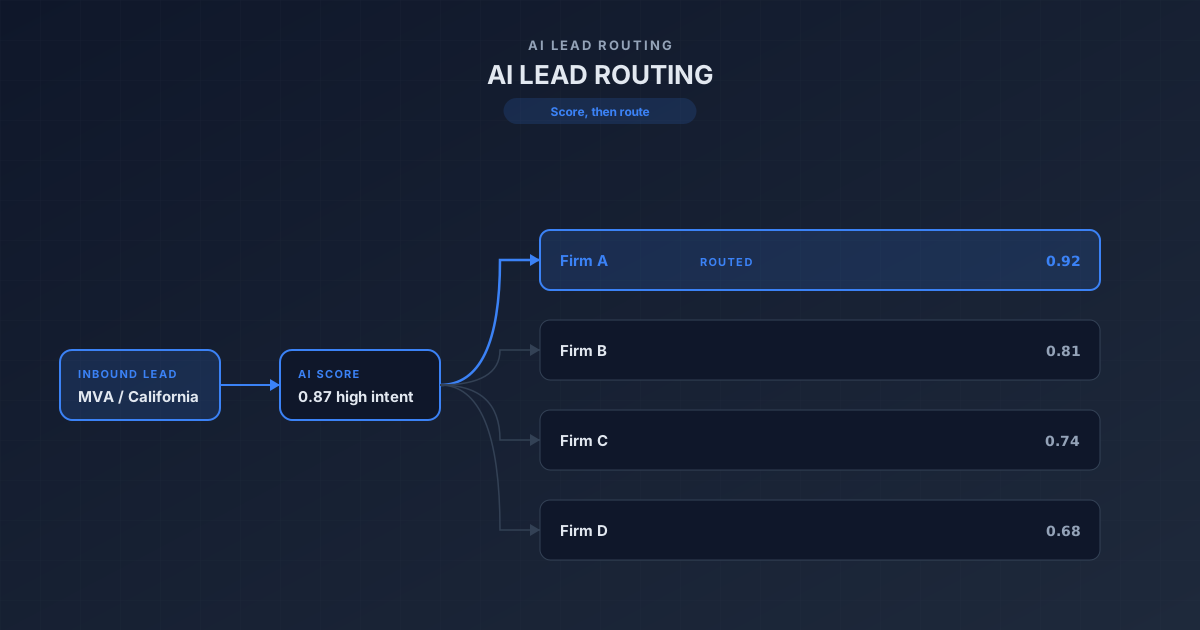
"AI lead routing" is the category term for software that uses a machine learning model to predict which buyer or sales rep is most likely to convert a given lead, then routes the lead accordingly in real time. Lead Distro AI's smart lead routing engine takes a rule-based approach to the same problem: it scores and routes every lead against the rules you configure, in under one second, across ping-post, weighted, and priority paths. Instead of a black-box model, you set the logic directly, weighting signals like lead score, source quality, buyer historical conversion rate, time of day, cap utilization, and vertical-specific intent markers yourself. The lead lands with whichever buyer your rules point to as the best match at that moment.
Start your free trial of Lead Distro AI. Lead scoring and rule-aware routing are included on every plan.
If you are still building a mental model of how routing logic works in general, read our guide to lead routing fundamentals first, then return here.
Key Takeaways
- AI lead routing predicts conversion probability per buyer per lead, not just rotation order or static geography rules.
- It pairs with lead scoring, which evaluates lead quality, and routes the right-quality lead to the right-fit buyer.
- Five lead routing tools worth evaluating in 2026 are Lead Distro AI (rule-based scoring and routing), Salesforce Einstein, HubSpot Operations Hub, LeadAngel, and Distribution Engine.
- Lead Distro AI pricing starts at $297/month (Starter, billed monthly), with a 7-day free trial.
What Is AI Lead Routing?
AI lead routing is the automated process of assigning an inbound lead to the buyer, sales rep, or distribution path most likely to produce a closed deal. The system evaluates lead attributes (source, score, vertical, geography, time-sensitive signals) and buyer attributes (historical close rate, current cap, response time, vertical fit) using a machine learning model, then makes the routing decision in under one second.
Three properties separate AI routing from traditional rule-based routing:
- Multivariate decisioning. Static rules consider one or two fields at a time. AI routing weighs every available signal simultaneously and learns which combinations actually predict conversion.
- Continuous learning. As leads route and close (or do not close), the model updates its weights. A buyer whose close rate drops automatically receives lower-priority routing the following week.
- Capacity awareness. AI routing accounts for daily caps, buyer pacing, and response-time SLAs in real time. A high-priority buyer at 95% cap utilization gets deprioritized in favor of the next-best buyer before throughput stalls.
How AI Lead Routing Works (Step by Step)
Lead Distro AI's rule-based routing pipeline runs in under 1 second from lead receipt to buyer delivery:
- Lead intake. The lead enters through a web form, API, Facebook Lead Ad, or inbound call.
- Validation and deduplication. Format checks, duplicate lead detection against the last 30-90 days, and DNC scrubbing.
- Lead scoring. The lead is scored against the rules you configure and assigned a 0-100 quality score. See our lead scoring guide for how the scoring rules work.
- Buyer eligibility filter. The system identifies which buyers can accept this specific lead based on vertical, geography, lead score floor, daily cap availability, and business hours.
- Routing decision. Among eligible buyers, the routing rules you configure determine expected revenue per lead and assign the lead to the highest-EV buyer.
- Real-time post. The lead is posted to the winning buyer's CRM, webhook, or ping-post endpoint within 200ms of the routing decision.
- Feedback loop. Disposition data (sale, no-contact, disqualified, dispute) feeds back to your dashboard so you can refine your scoring and routing rules.
See the full pipeline in action with our interactive product tour.
AI Lead Routing vs Rule-Based Routing
| Capability | Rule-Based Routing | AI Lead Routing |
|---|---|---|
| Decision logic | Static if-then rules | ML model predicting expected revenue per lead |
| Signals evaluated per lead | 1-3 (geo, vertical, source) | 20-50+ (score, buyer history, capacity, time, intent) |
| Adapts to changing buyer performance | No, requires manual rule updates | Yes, retrains from disposition data |
| Capacity awareness | Manual cap enforcement | Real-time cap pacing built into routing |
| Setup time | Days, ongoing tuning required | Hours, self-tuning |
| Best for | Simple buyer networks under 5 destinations | Multi-buyer networks, high-volume operations |
The practical difference: rule-based routing answers "which buyer matches the lead?" AI routing answers "which buyer is most likely to make me money on this specific lead?" Those are different questions, and the second one drives margin.
5 Best AI Lead Routing Tools in 2026
1. Lead Distro AI: Best Rule-Based Lead Routing for PPL Agencies and Lead Brokers
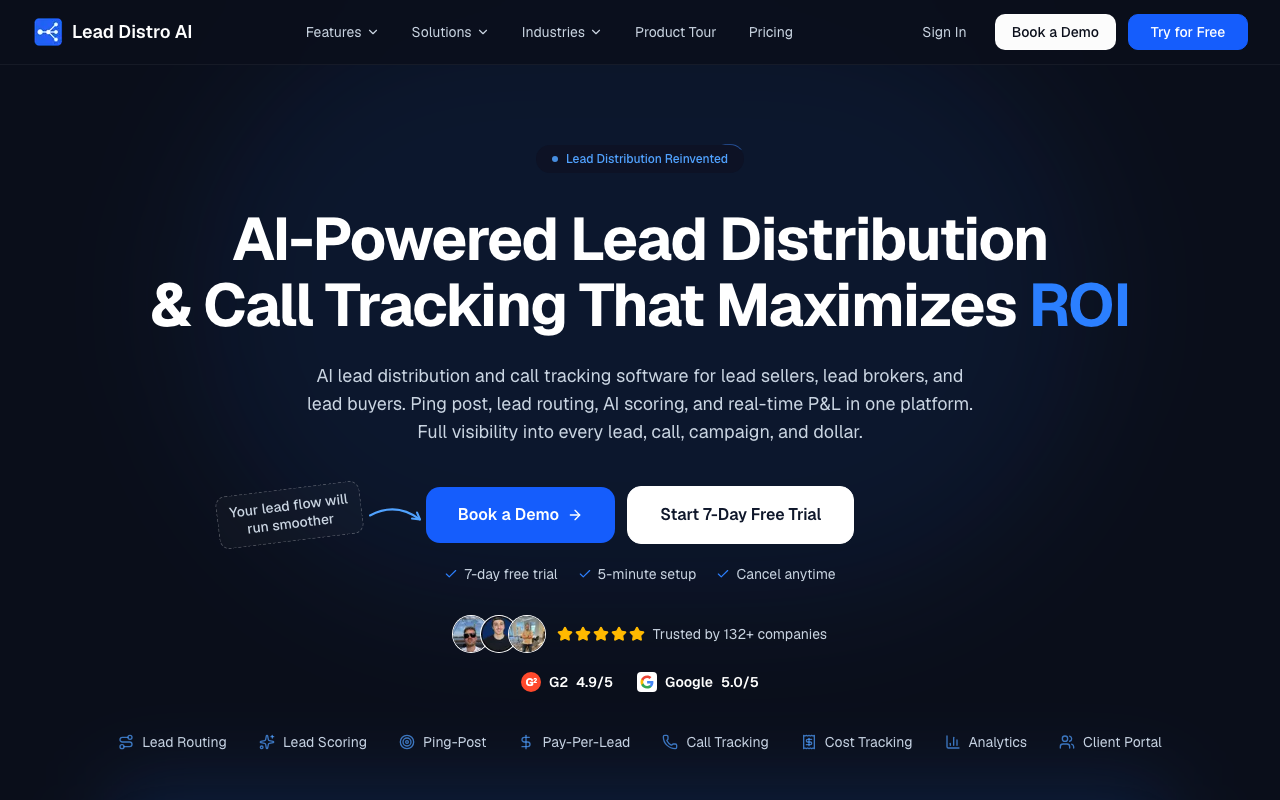
Best for: Pay-per-lead agencies, lead brokers, and call centers running multi-buyer networks.
Lead Distro AI pairs rule-based lead scoring with rules-aware routing across four methods: waterfall, round robin, weighted, and ping post. Every lead is scored against your rules before routing begins, eligibility filters identify which buyers can accept the lead, and the routing engine selects the buyer with the highest expected revenue accounting for current cap utilization and historical close rate. The full intake-to-post cycle completes in under 1 second.
Key routing features:
- Rule-based scoring on every lead before routing
- Four distribution methods with rule-driven prioritization inside each
- Real-time cap pacing prevents top buyers from stalling at peak hours
- Buyer-specific score thresholds (premium accounts only see 80+ scores)
- Disposition feedback lets you refine your scoring and routing rules over time
Pricing: $297/mo Starter, $497/mo Growth, Scale by quote. See the full pricing breakdown.
Setup time: Same-day. Connect Facebook Lead Ads, Zapier, webhook, or API and start routing.
2. Salesforce Einstein: Best for Salesforce-Native Sales Teams
Best for: Enterprise sales organizations already running Salesforce Sales Cloud with internal SDR/AE teams.
In our view, Einstein is a strong fit when your buyers are internal reps who already work inside Salesforce, and a weaker fit for external buyer networks where leads need to post to outside endpoints.
3. HubSpot Operations Hub Enterprise: Best for Mid-Market B2B SaaS
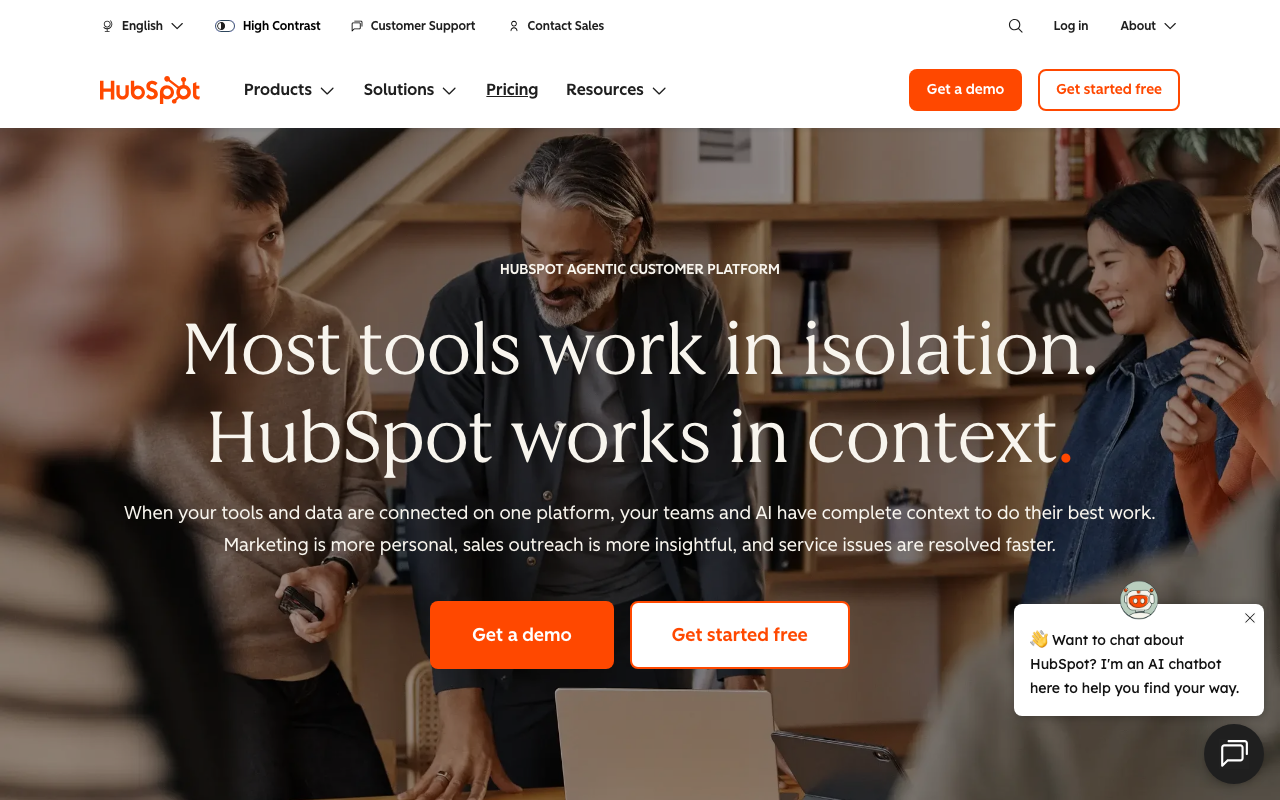
Best for: B2B SaaS companies routing inbound demo requests to AEs across territories or accounts.
In our view, Operations Hub is better suited to inbound SaaS workflows than to external buyer marketplaces.
4. LeadAngel: Best for Salesforce Round Robin and Territory Routing
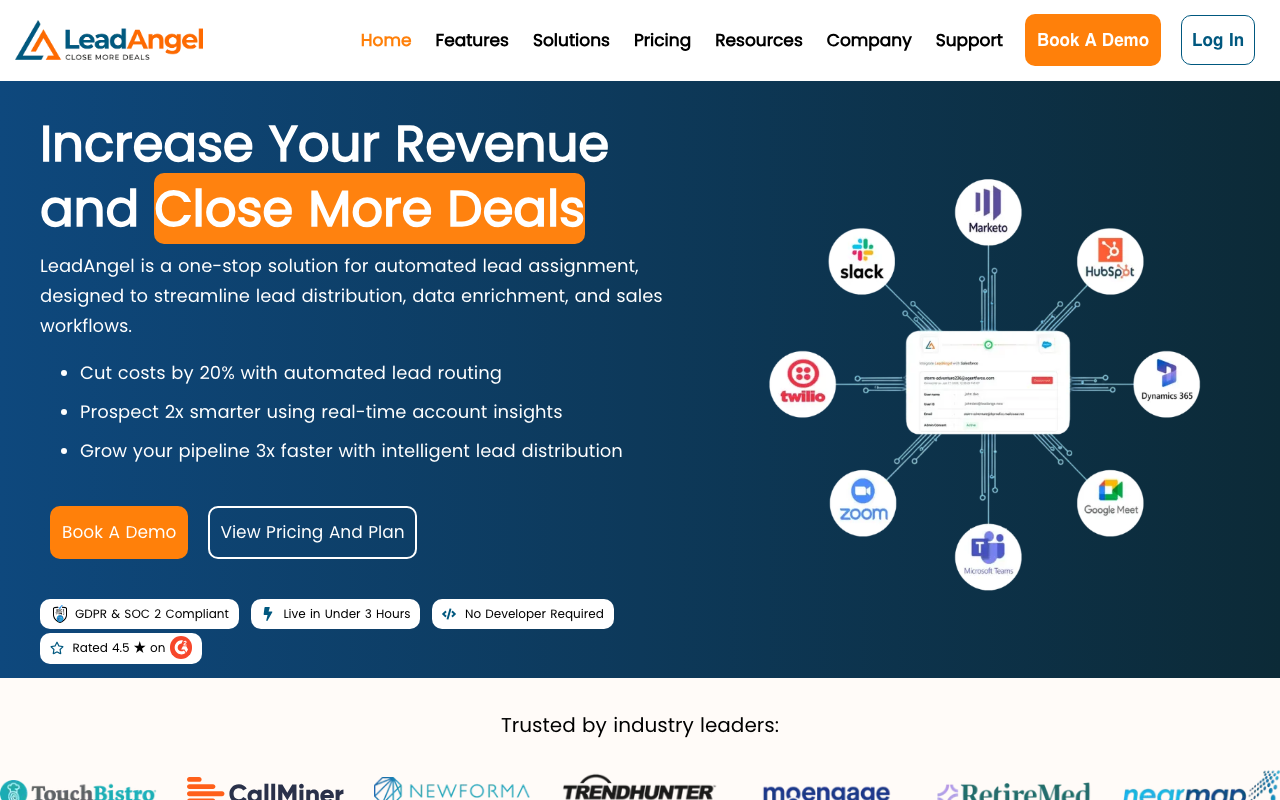
Best for: Salesforce-based sales teams that need fair round robin and territory matching.
LeadAngel sits inside Salesforce and handles round robin, weighted round robin, and territory routing, with rep availability and assignment caps. Its routing is rules-based. LeadAngel is built to route leads to sales reps inside B2B sales teams, which in our view makes it a solid Salesforce-native option for that use case.
5. Distribution Engine by NC Squared: Best for Custom Salesforce Routing
Best for: Salesforce orgs with complex routing logic.
In our view, Distribution Engine is worth evaluating for sales ops teams that want to configure internal rep routing inside Salesforce.
For a broader comparison of routing platforms beyond AI specifically, see our best lead routing software roundup for 2026.
Multilingual AI Lead Routing (Spanish-Language Leads)
English-only intake breaks the moment a campaign runs Spanish creative. Personal injury, insurance, and mortgage advertisers have all pushed into Spanish-speaking markets, and a Spanish caller routed to an English-only intake rep converts at a fraction of the rate.
Lead Distro AI has native Spanish-language routing: Spanish intake forms, Spanish IVR for inbound calls, and the ability to route leads to Spanish-speaking buyer pools or rep queues only. If you advertise in Spanish, treat this as a hard requirement rather than a nice-to-have.
When AI Lead Routing Is Worth It (and When It Is Not)
Worth it when:
- You have 3+ buyers (or sales reps) with different close rates or payout tiers
- You have at least 30 days of disposition history for the model to learn from
- Your lead volume is 500+ per month (enough signal to train against)
- Lead value is high enough that 20-30% conversion lift moves real money
Not worth it (yet) when:
- You have one buyer or one rep, there is no routing decision to make
- You have fewer than 30 days of conversion data, the model has nothing to learn from
- Your lead volume is under 100/month, too little signal to train
For pre-AI operations, start with a rule-based router that has clear waterfall logic and graduate to AI routing once you have 30-60 days of disposition data.
AI Lead Routing by Vertical
| Vertical | Why AI Routing Helps | Key Signals to Score |
|---|---|---|
| Legal / PI | Premium buyers have hard daily caps; AI prevents stall-outs | Case type, injury severity, state, time of incident |
| Insurance | State licensing match + AEP/OEP timing matters | Line of business, state, age, qualifying event |
| Mortgage | NMLS state filter + refi vs purchase routing | Loan purpose, credit band, state, property type |
| Solar | Territory routing + homeowner status | ZIP, homeowner verification, utility bill range |
| Home services | Trade routing + emergency vs scheduled | Trade (HVAC/roofing/plumbing), urgency, ZIP |
In every vertical, AI routing outperforms static rules when buyer-level performance varies, and it almost always does.
Frequently Asked Questions
How is AI lead routing different from lead scoring?
Lead scoring evaluates how likely a lead is to convert and assigns a quality score. AI lead routing uses that score plus buyer-side signals to decide which buyer should receive the lead. Scoring is about the lead. Routing is about matching the lead to the right destination. Modern platforms like Lead Distro AI pair both in one pipeline so the score directly informs the routing decision.
Do I need a lot of historical data to use AI lead routing?
You need at least 30 days of disposition data (sale, no-sale, disqualified) before an AI routing model can outperform rule-based routing in your specific operation. With under 30 days of data, the model is essentially routing randomly. Most agencies start with rule-based routing in week 1, layer scoring in week 4, and switch on AI routing once they hit 30-60 days of clean disposition data.
Can AI lead routing handle ping post auctions?
Yes, on platforms that support both. Lead Distro AI runs ping post auctions with score thresholds applied per buyer: premium buyers only see 80+ scored leads in the auction.
What are the best AI lead routing tools for North Richland Hills TX practices?
For local service-based practices (medical, legal, home services) in North Richland Hills or similar mid-size metros, the best AI lead routing tool depends on your buyer model. If you are routing leads to internal reps inside a single business, HubSpot Operations Hub or Salesforce Einstein work well. If you are running a lead generation business that sells leads to multiple local buyers, Lead Distro AI is the better fit because it handles external buyer payouts, multi-buyer waterfall routing, and ZIP-based territory matching.
How does AI lead routing compare to Salesforce Flow for lead routing?
Salesforce Flow is Salesforce's workflow builder. A purpose-built lead distribution platform adds a scoring and prioritization layer plus external destination support. If you are running a lead distribution agency that pays external buyers, you need a platform like Lead Distro AI that posts to Salesforce as one of many destinations.
Does AI lead routing comply with TCPA?
AI lead routing itself does not change TCPA obligations. Consent capture (TrustedForm, Jornaya), DNC scrubbing, time-of-day rules, and one-to-one consent (post-2025 FCC ruling) still apply regardless of how the lead is routed. AI routing platforms ingest consent tokens at intake and forward them to the winning buyer. Read our TCPA compliance guide for lead distribution for the six controls every platform must enforce.
Conclusion
AI lead routing is the difference between a lead distribution operation that compounds and one that plateaus at $20K-$30K/month. Once buyer count exceeds three and lead volume crosses 500/month, the marginal value of each routing decision is high enough that 20-30% conversion lift moves real money. Most agencies graduate from manual routing to rule-based routing to AI routing in that order over 60-90 days.
For agencies and lead brokers running multi-buyer networks, Lead Distro AI is the most direct path: rule-based lead scoring, rule-aware routing across four methods, ping post auctions, and real-time P&L all in one platform.
Ready to upgrade from manual routing to routing that actually scores every lead? Lead Distro AI scores every lead against your rules before routing and selects the buyer with the highest expected revenue. Start your 7-day free trial or tour the leads workflow to watch lead scoring and routing on real lead records.
About the Author
Founder & CEO of Lead Distro AI & Great Marketing AI
UC Berkeley graduate and former software engineer at Microsoft. Rafael built Lead Distro AI after managing over $10M in ad spend for performance marketing agencies (pay-per-lead and pay-per-call), including running campaigns for Neil Patel. He combines deep software engineering expertise with hands-on performance marketing experience to build tools that help these agencies scale profitably.
About Lead Distro AI
Lead Distro AI: AI-Powered Lead Distribution & Call Tracking That Maximizes ROI
The modern platform for pay-per-lead and pay-per-call agencies. Route, score, and deliver leads with AI-powered automation and real-time P&L tracking. Built for performance marketing agencies and lead buyers across legal, insurance, mortgage, solar, and home services verticals.
4 Distribution Methods
Waterfall, Round Robin, Weighted, Ping-Post
Ping-Post Auctions
Real-time bidding with sub-second routing
Real-Time P&L Reporting
Track revenue, costs, and profit per campaign
Call Tracking
Assign tracking numbers, record calls, and attribute conversions
Lead Scoring
Score every lead before routing to maximize conversion
Partner Portal
Self-serve dashboard for buyers to track leads